



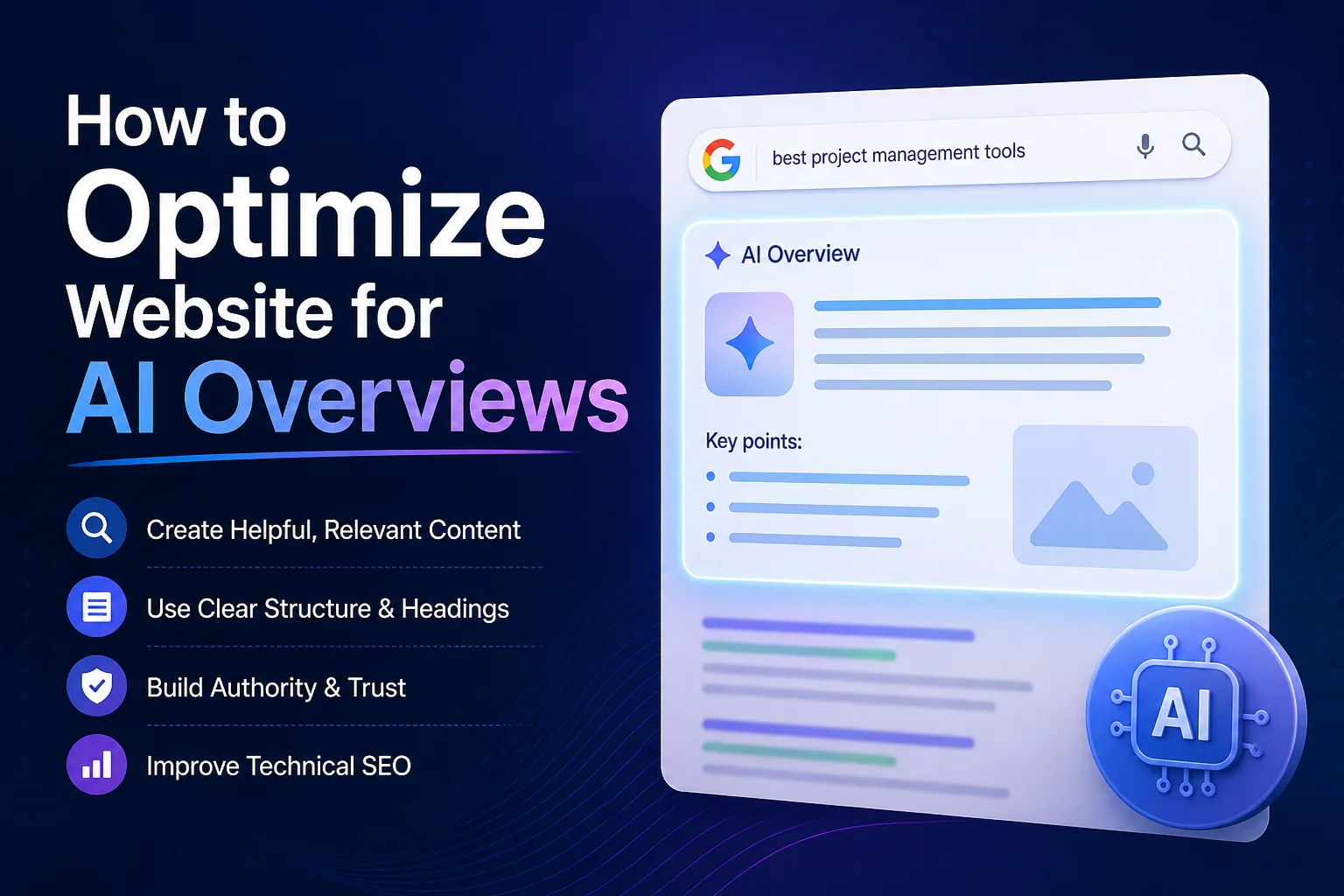
On January 27, 2026, Google switched AI Overviews globally to Gemini 3 and replaced 42% of previously cited domains overnight. The optimization playbook that worked in mid-2025 no longer applies. Ahrefs’ analysis of 4 million AIO URLs confirms the shift: the top-10 overlap for AI Overview citations has collapsed from 76% to 38% in less than nine months. This guide covers the 7 citation signals that actually determine your visibility now, and what to do about each one.
What AI Overviews Actually Are (And Why Rankings Alone Don’t Win Citations)
AI Overviews are generated by Gemini, Google’s large language model, using a process called retrieval-augmented generation (RAG). Gemini does not simply pull the top-ranked page. It decomposes the original query into multiple sub-queries, retrieves results for each, and synthesizes a single response from the most extractable sources across all of them.
This mechanism is called query fan-out. It is the most important concept to understand before optimizing anything. A page that ranks #1 for “how to optimize for AI Overviews” may never be cited if it does not also cover the sub-topics Gemini generates around that query – things like structured data, entity coverage, and content freshness.
According to Ethan Lazuk, SEO Consultant and a leading voice on fan-out strategy: “The more relevant you can make the content to the sub-queries Google generates, the stronger your chances of appearing in the AI Overview for the head term.”
The 7 Ranking Signals for AI Overview Citations
A Wellows study analyzing 15,847 AI Overview results identified seven core signals that determine whether Gemini cites your content. These are not abstract quality markers. Each has a measurable correlation with citation probability.
1. Semantic Completeness, the Signal That Predicts 4.2x Citation Lift
Semantic completeness measures how fully your content answers a query without requiring the reader to look elsewhere. According to the Wellows study, content scoring 8.5 out of 10 on semantic completeness is 4.2 times more likely to be cited in AI Overviews.
The practical target: structure each answer block as a self-contained unit of 134 to 167 words. One question, one complete response, no cross-referencing required. If Gemini can lift a passage and present it without context from the rest of your page, that passage is extraction-ready.
2. Multimodal Content Integration, the 156% Selection Multiplier
Pages that combine text, images, video, and structured data see a 156% higher selection rate than text-only pages, according to Wellows’ correlation analysis (r=0.92). This is the single largest ranking shift observed in 2025.
You do not need all four formats on every page. Start by adding original images with descriptive alt text and at least one embedded video where the topic supports it. Schema markup ties the signals together, telling Gemini exactly what each content type represents.
3. Entity Knowledge Graph Density, the 4.8x Probability Boost
Pages with 15 or more connected entities show a 4.8 times higher citation probability than thin pages, according to Wellows. An entity is any named concept – a person, tool, platform, algorithm, or brand – that Google’s Knowledge Graph recognizes.
A page about AI Overviews that only explains what they are will consistently lose to a page that also covers Gemini 3, query fan-out, structured data, E-E-A-T, RAG, Search Console limitations, and zero-click behavior. The second page gives Gemini more answer paths. Cover the connected concepts, not just the core keyword.
4. Structured Data Markup, the 73% Citation Probability Lift
Schema markup raises citation probability by 73%, according to the AI Overview Ranking Factors Study. It gives Gemini a machine-readable map of your content, clarifying what is an FAQ, what is a how-to step, and who the author is.
For an optimization guide like this topic, prioritize these schema types: Article, FAQPage, HowTo, Speakable, Person, and Organization. Implement them in JSON-LD format. Pages without schema risk being skipped in favor of competitors who have given Gemini cleaner signals.
As Crystal Carter, Head of AI Search and SEO Communications at Wix, notes: “The future of AI search is optimizing for the AI agents. Pages that are machine-readable at the structural level are positioned for every new format that follows.”
5. E-E-A-T Authority Signals, Present in 96% of Cited Pages
E-E-A-T (Experience, Expertise, Authoritativeness, Trustworthiness) is present in 96% of pages cited in AI Overviews. This is not a soft quality signal. It is a hard filter Gemini applies before selecting sources.
Add author schema to every article with real credentials. Include a named byline, a linked author bio, and role or title context. Earn third-party brand mentions through digital PR and guest contributions on authoritative sites. A Princeton study on citation bias in AI search confirms that AI engines strongly favor earned media over brand-owned content.
6. Real-Time Factual Verification and Content Freshness
Gemini 3 has a measurable freshness bias. Content from 2023 consistently loses ground to 2026 equivalents on the same topic, according to SE Ranking’s Gemini 3 behavior analysis. Adding a verifiable citation to a data point raises citation probability by 89%.
Audit your highest-traffic pages quarterly. Update statistics, replace outdated examples, and add a visible “Last Updated” timestamp. This is not cosmetic. It signals to Gemini that your content reflects the current state of the topic.
7. Vector Embedding Alignment, the Semantic Matching Layer
Vector embedding alignment (r=0.84 correlation with citation probability) measures how closely your content’s semantic pattern matches the user query, not just the keywords. Gemini does not match phrases. It matches meaning.
Write in natural, varied language. Use synonyms and related expressions rather than repeating the target keyword. Cover sub-topics that a searcher would logically want answered after the main question. The “People Also Ask” box and related queries in Search Console are your fastest research tools for identifying these sub-topics.
Query Fan-Out: The Mechanism Most SEOs Are Still Ignoring
A Surfer SEO analysis of 10,000 keywords found that pages ranking for fan-out queries are 161% more likely to be cited in AI Overviews than pages ranking only for the head term. Ranking for fan-out queries is also 49% more likely to earn a citation than ranking for the head term alone.
Jim Yu, CEO of BrightEdge, describes the structural implication clearly: “We’re already seeing a massive rise in agentic crawlers – AI that searches and acts on behalf of users. Content architecture needs to match how these systems retrieve, not just how humans browse.”
The strategic response is to build a content cluster around each target topic, not a single optimized page. A hub page covering the core query should be supported by spoke pages addressing comparisons, alternatives, implementation steps, and use-case specifics. Gemini’s fan-out queries frequently surface these spoke pages, even when they do not rank in the top 10 for the original search.
The YouTube Signal: The Most Overlooked Citation Factor in 2026
Ahrefs’ research across 75,000 brands identified YouTube mentions as the strongest correlating factor with AI Overview visibility among all signals tested. An OtterlyAI study drawing from over 100 million citation instances confirmed YouTube as the second most-cited social platform in AI search citations.
The mechanism connects directly to query fan-out. YouTube videos frequently rank for the sub-queries Gemini generates when decomposing a head term, even when those videos do not appear in the top 100 for the original query. This makes video content a citation multiplier that operates independently of your organic search rankings.
To activate this signal: publish video content on your core topics, write descriptive titles and transcripts that match the sub-questions your audience asks, and include your brand name consistently in descriptions. The citation signal is driven by text signals in the video metadata, not the video itself.
How to Track Your AI Overview Visibility
Google Search Console shows limited AIO data, but it is your starting point. Track impressions and CTR for your target pages. A rising impression count with a falling CTR on the same query often signals that an AI Overview appeared and absorbed the click.
For dedicated AIO tracking, use Ahrefs Brand Radar, SE Ranking’s AI Results Tracker, or Peec.ai, which monitors brand citations across generative search engines. Manually audit your top 10 target queries weekly by searching them in Google and noting whether your site appears as a citation source.
The CTR picture is improving. Seer Interactive data shows AIO-triggered CTR climbed from 1.3% in December 2025 to 2.4% in February 2026, an 85% recovery in two months. Cited pages earn 35% more organic clicks and 91% more paid clicks than non-cited competitors on the same SERP. The goal is citation, not avoidance.
FAQs
Does schema markup guarantee an AI Overview citation?
No. Schema markup raises citation probability by 73% but does not guarantee inclusion. It functions as a trust signal that makes your content easier for Gemini to parse. Combined with strong E-E-A-T and semantic completeness, it significantly improves your odds.
Do you need to rank in the top 10 to appear in AI Overviews?
Not anymore. Ahrefs’ April 2026 analysis confirms that only 38% of cited pages rank in the top 10 for the original query. Pages ranking for fan-out sub-queries are frequently cited without appearing on page one for the head term.
How has Gemini 3 changed AI Overview optimization?
Gemini 3, launched January 27, 2026, replaced 42% of previously cited domains and generates 32% more sources per response than its predecessor. It relies more heavily on query fan-out, making topical cluster coverage more important than optimizing a single page.
How long does it take to get cited in AI Overviews?
There is no fixed timeline. Sites that implement semantic completeness, schema markup, and content freshness together have reported citation appearances within four to six weeks. Consistency across a content cluster accelerates the process more than any single page change.
Is YouTube important for AI Overview visibility?
Yes. Ahrefs identifies YouTube mentions as the strongest correlating signal with AIO visibility among all tested factors. Video content that covers your core topics and sub-queries acts as a citation multiplier that operates independently of your standard organic rankings.
