



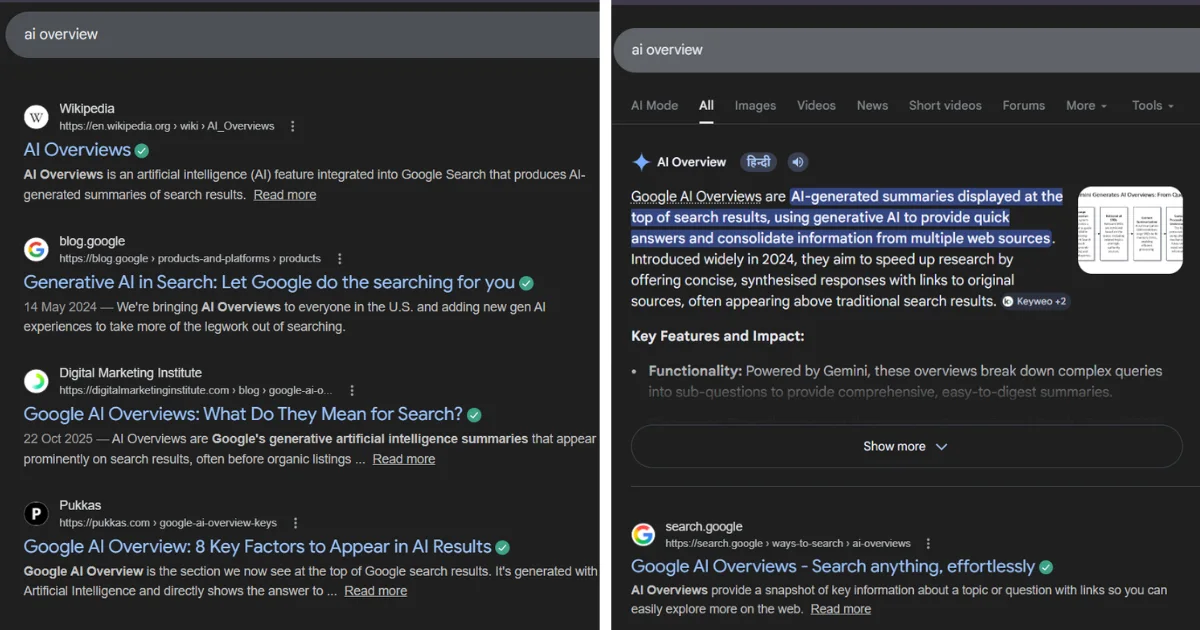
Google no longer just finds information — it creates it. Here is the 8-point framework to get your content cited, referenced, and trusted in AI-powered search before your competitors figure it out.
Google processes 14 billion search queries every day. In 2026, more than 50% of those queries now trigger an AI-generated response at the very top of the results page — before a single blue link is shown. The old game of chasing rank position one? It has not disappeared. But it is no longer enough.
This is the reality of Google’s Search Generative Experience — now officially called AI Overviews — and it represents the most fundamental restructuring of organic search since Google replaced the original directory-based web in 1998.
The shift is not coming. It is already here. A 2025 Semrush analysis of more than 10 million keywords found AI Overviews appearing on nearly 25% of all queries at their July peak. A Reuters Institute report published in January 2026 found that news publishers now expect search referral traffic to fall 43% within three years, as AI answer engines intercept queries before users ever reach a website. And Chartbeat data cited in the same report shows that organic Google traffic fell 33% globally between November 2024 and November 2025 alone.
The brands and content creators winning in this new landscape are not necessarily the ones with the highest domain authority or the largest backlink portfolios. They are the ones whose content is structured, cited, and trusted enough for Google’s AI to quote directly inside an AI Overview.
This guide gives you the complete, practical framework to become one of those sources. You will understand what SGE actually is, why it is reshaping traffic economics, and — most importantly — the 8-point optimization system you can implement right now to earn citations, protect traffic, and build authority that compounds across both traditional and AI-powered search.
What SGE Really Is — And Why “AI Overviews” Is Not Just a Rebrand
Most coverage of SGE treats the name change from “Search Generative Experience” to “AI Overviews” as a cosmetic update. It is not. Understanding the difference between what SGE was and what AI Overviews has become is the first step toward optimizing for it effectively.
Google introduced Search Generative Experience in May 2023 as a Search Labs experiment — an opt-in feature available to U.S. users running Chrome or the Google app. It used an early version of Google’s Pathways Language Model 2 (PaLM 2) to generate AI-powered answer snapshots above traditional organic results. The conversational mode that allowed multi-turn follow-up queries was central to the original SGE experience.
When Google officially launched AI Overviews in May 2024, powered by a customized Gemini model, the conversational mode was removed from the standard interface. What remained — and what has since scaled to over 200 countries and 40 languages — is the AI-generated snapshot itself: a synthesized, multi-source answer that appears at the top of the SERP for qualifying queries.
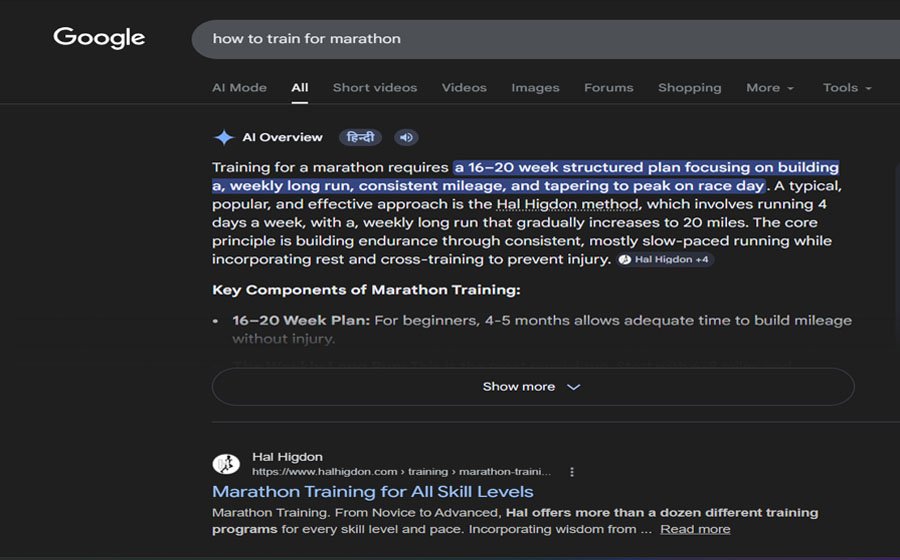
The modern AI Overview has three structural components every SEO needs to understand:
- The AI Snapshot: A 150–300 word synthesized answer generated from multiple web sources, written in natural language to directly address the user’s query.
- Citation Cards: Two to seven source links displayed alongside the snapshot, giving credit to the pages whose content was used to generate the answer. These are the citation positions you are competing for.
- Suggested Follow-Ups: Related questions generated by Gemini that appear below the snapshot, extending the search session within Google’s environment.
Gary Illyes of Google confirmed the mechanism in a public interview with SEO researcher Kenichi Suzuki: Gemini AI Overview and AI Mode both use Google Search for grounding, issuing multiple queries to Google’s index before synthesizing a response. This is critical. It means the path to AI Overview visibility runs directly through traditional SEO fundamentals — not around them.
“SGE operates on a completely different level compared to traditional search. If you aim to be featured in Google SGE, you’ll need to develop a distinct strategy tailored to this new environment. It’s a whole new game.”
Bart Goralewicz, Founder, Onely
AI Overviews are not universal across all query types. The 2025 Semrush study found them appearing most frequently in informational queries (questions beginning with “what,” “how,” and “why”), with Science (25.96% of keywords), Computers & Electronics (17.92%), and People & Society (17.29%) showing the highest saturation. Navigational queries — brand and destination searches — grew dramatically from under 1% to over 10% of AI Overviews between January and November 2025, signaling a rapid expansion of Google’s AI ambitions beyond purely informational content.
How SGE Is Reshaping Organic Traffic — The Numbers You Cannot Ignore
The traffic implications of AI Overviews are not uniform — and the nuance matters more than the headline numbers. The instinctive fear that AI Overviews uniformly destroy organic clicks is partly wrong, but the threat to specific content categories is very real.
The most severe impacts have fallen on specific publisher categories. DMG Media, which owns MailOnline and Metro, reported nearly 90% CTR declines for certain content types when AI Overviews surface above their results. The Daily Mail’s desktop CTR reportedly dropped from 25.23% to 2.79% for queries where an AI Overview appeared directly above their visible link. Educational platform Chegg reported a 49% decline in non-subscriber traffic between January 2024 and January 2025, attributing the drop in part to AI Overviews providing educational answers directly on the SERP.
However, the Semrush 2025 data reveals a more complicated picture. When comparing the same keywords before and after an AI Overview appeared, zero-click rates actually fell from 33.75% to 31.53%. AI Overviews do not automatically reduce clicks — in many cases, users who read the AI snapshot and want more detail click through at higher intent levels than users who browse traditional results.
“Most people think AI search is just SEO evolving. The mistake is treating it as the same strategic problem. SEO is built around earning visibility that converts into clicks. AI search optimization is about supplying information so AI agents can find, trust, and use it — without a user ever visiting the site.”
Crystal Carter, Head of AI Search & SEO Communications, Wix
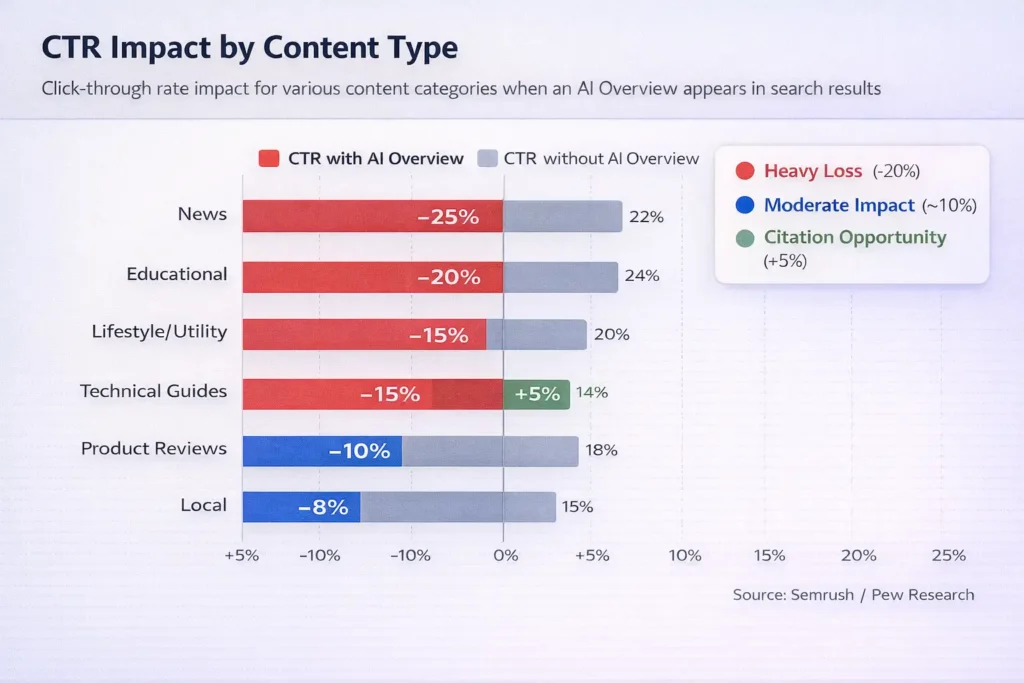
The strategic implication is clear: content that answers a query in full without requiring a visit (basic definitions, simple how-tos, weather) loses the most. Content that goes beyond what an AI snapshot can contain — original research, proprietary data, nuanced analysis, step-by-step implementation guides — retains and often grows its traffic through high-intent citations.
The new success metric is not just click-through rate. It is citation rate — how often your content is selected as a source within AI-generated answers. A citation in an AI Overview delivers brand exposure to every user who reads that answer, even if only a fraction click through. For brand-building and top-of-funnel awareness, this is a fundamentally new visibility channel with no equivalent in traditional SEO.
Understanding the New Ranking Framework: SEO, GEO, and AEO Explained
The terminology around AI search optimization has fractured into overlapping acronyms that many marketers use interchangeably. They are not interchangeable. Understanding the precise distinctions between SEO, GEO, and AEO determines which tactics to prioritize for which goals.
| Discipline | Full Name | Primary Goal | Success Metric | Platform Focus |
|---|---|---|---|---|
| SEO | Search Engine Optimization | Rank in the 10 blue links | Rank position, organic CTR | Google, Bing |
| GEO | Generative Engine Optimization | Be cited in AI-generated answers | Citation rate, share of AI voice | Google AI Overviews, ChatGPT Search, Perplexity, Copilot |
| AEO | Answer Engine Optimization | Be the best direct answer to a specific question | Featured snippet wins, voice search inclusion | Google, voice assistants, conversational AI |
In 2026, these three disciplines do not operate in isolation. A Princeton research paper that helped coin the term GEO, along with a 2025 follow-up study on citation bias in AI search, found that AI engines strongly favor earned media — authoritative third-party sources — over brand-owned content. This means the signal architecture of traditional SEO (backlinks, domain authority, content depth) directly feeds the citation eligibility of GEO.
The convergence principle: SEO is the prerequisite for GEO. Without the technical foundation of traditional search optimization — clean crawlability, indexation, strong architecture — no amount of content restructuring will get you cited in AI Overviews. The AI engines use Google’s own index as their grounding mechanism. If Google cannot reliably crawl and understand your site, Gemini cannot cite it.
The 8-Point SGE Content Optimization Framework
What follows is not a list of generic best practices. Each of the eight tactics below is grounded in the specific mechanisms by which Google’s Gemini model selects content for AI Overview citations — based on research, confirmed algorithmic signals, and data from publishers who have successfully grown their AI Overview citation rates in 2025 and 2026.
1. Answer-First Content Architecture
Google’s Gemini model does not read your entire article before deciding whether to cite it. Research from content teams at Search Engine Land and Conductor confirms that AI systems prioritize content where the direct answer to a query appears in the first 40–60 words of the relevant section — not buried after three paragraphs of context.
This is the “inverted pyramid” model applied to AI search. Start every H2 section with a concise, direct answer to the question implied by that heading. Then support it with evidence, explanation, and depth. The concise answer is what gets pulled into the AI Overview snapshot. The depth is what drives the click-through for users who want more.
For this article, the target query is “how to optimize content for SGE.” Notice that the section you are reading opens with a direct, actionable statement about how Gemini selects content, followed immediately by the practical implication. That is the answer-first structure in action.
2. E-E-A-T Signal Maximization
Google’s E-E-A-T framework — Experience, Expertise, Authoritativeness, Trustworthiness — has been a quality signal since 2018. In the AI Overview era, it is the primary eligibility filter. Google’s AI systems are trained to assess E-E-A-T at a signal level, not just a content level, which means the trust signals embedded in your page architecture matter as much as the words on the page.
The four E-E-A-T signals that AI systems weight most heavily are:
- Author credentials: Named author with a linked bio, professional title, publishing history, and ideally third-party verification (LinkedIn profile, industry mentions, conference speaker credits).
- First-hand experience markers: Language that signals direct experience — “in our testing,” “based on data from our client campaigns,” “we observed” — rather than second-hand aggregation.
- Citation of primary sources: Links to original research (Pew Research, Gartner, Google’s own blog posts, peer-reviewed studies) rather than aggregated news articles.
- Corroboration signals: Mentions of your content or brand on other authoritative sites. AI engines use the presence of third-party references as a trust amplifier. This is why digital PR for SEO has become an explicit GEO tactic in 2026.
3. Topical Authority — Why One Great Page Is No Longer Enough
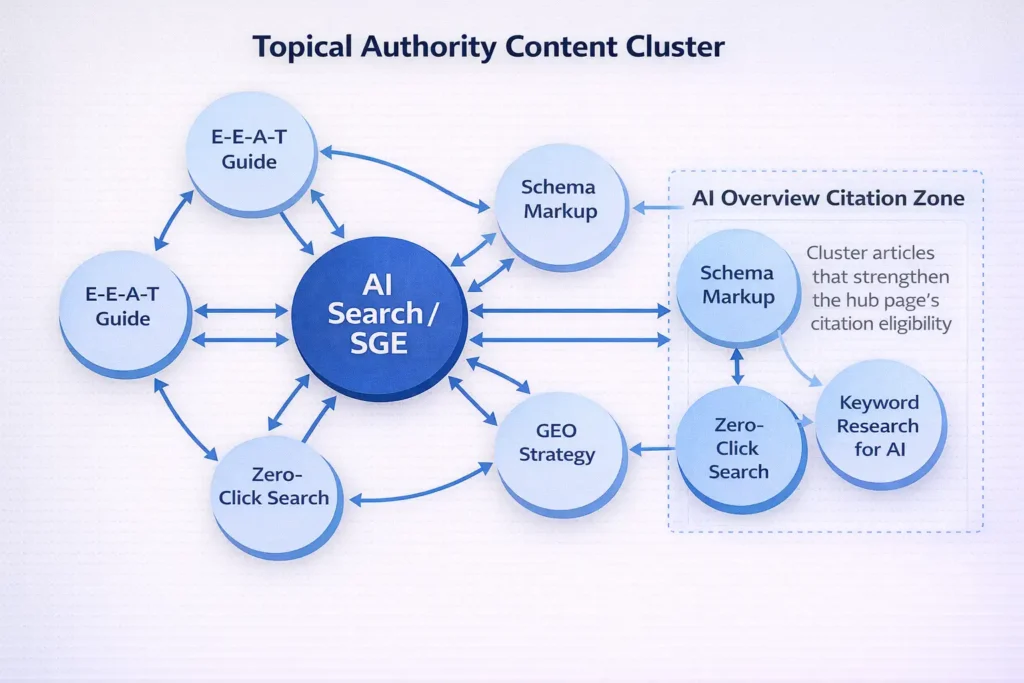
Google’s AI evaluates content at the site level before deciding to cite individual pages. A single exceptional article on SGE optimization, published on a site that otherwise covers unrelated topics, is less likely to be cited than a comparable article published on a site with deep, interconnected content about SEO, AI search, and digital marketing.
This is the topical authority principle — and it is more rigorous in the AI Overview era than in traditional SEO. AI systems map internal link structures to build a semantic graph of what your site “knows.” If your content about SGE is isolated from content about E-E-A-T, schema markup, and keyword strategy, the AI system has less confidence in your site as a reliable reference on the topic.
The practical implication: for CliqNex and any content-driven site competing for AI Overview citations, the priority is not just one exceptional pillar article — it is a content cluster of interconnected pieces that collectively demonstrate domain expertise. The SGE article links to your AI Overviews article. That article links to your E-E-A-T guide. That guide links to your schema markup tutorial. The cluster signals authority that no single page can.
4. Conversational and Long-Tail Keyword Strategy
The keyword architecture of AI-powered search is fundamentally different from the keyword architecture of traditional SEO. Google’s Gemini does not match exact keywords — it interprets intent, context, and the natural language structure of the query. This shifts the optimization target from keyword density to query-question alignment.
High-performing SGE content is structured around natural language questions — the actual phrasing real people use when they speak to a search engine or AI assistant. Instead of targeting the keyword “SGE optimization,” the content should be structured around questions like “How do I get my content cited in Google AI Overviews?” and “What does Google’s AI look for when selecting sources?”
Voice search amplifies this shift. As Google integrates AI Overview responses into voice-based queries through Google Assistant and Android devices, content optimized for conversational phrasing gains an additional discovery channel that keyword-stuffed content cannot access.
5. Structured Data and Schema Markup
Schema markup is the most direct technical signal you can send to Google’s AI systems. While traditional SEO benefits from schema markup primarily through rich snippet eligibility, AI Overviews use structured data as a parsing aid — a way to understand the type, structure, and authority of content without relying entirely on semantic inference.
The schema types with the highest confirmed impact on AI Overview citation eligibility in 2026 are:
- Article schema with
author,datePublished,dateModified, andpublisherproperties — establishes content freshness and authorship for AI systems. - FAQPage schema — structures question-answer pairs in a format that AI can directly extract and synthesize. One of the clearest signals of answer-intent content.
- HowTo schema — for step-by-step instructional content, this schema tells AI systems the content is procedural and sequentially structured, increasing citation eligibility for “how to” queries.
- Speakable schema — explicitly marks content sections as suitable for text-to-speech delivery, which aligns with voice-driven AI Overview responses.
- Organization and Person schema — establishes the entity identity of your brand and authors, feeding directly into AI systems’ entity-trust evaluation.
{
  "@context": "https://schema.org",
  "@type": "Article",
  "headline": "SGE Optimization Guide 2026",
  "author": {
    "@type": "Person",
    "name": "Your Author Name",
    "url": "https://cliqnex.com/author/name",
    "jobTitle": "SEO Strategist",
    "worksFor": {
      "@type": "Organization",
      "name": "CliqNex"
    }
  },
  "publisher": {
    "@type": "Organization",
    "name": "CliqNex",
    "url": "https://cliqnex.com",
    "logo": {
      "@type": "ImageObject",
      "url": "https://cliqnex.com/logo.png"
    }
  },
  "datePublished": "2026-03-12",
  "dateModified": "2026-03-12",
  "description": "The complete framework for optimizing content for Google SGE and AI Overviews in 2026.",
  "mainEntityOfPage": {
    "@type": "WebPage",
    "@id": "https://cliqnex.com/sge-search-generative-experience-optimization"
  }
}
6. Neutral, Informative Language — Why Promotional Tone Kills Your Citation Chances
This is the optimization signal most content marketers overlook, and it is one of the most consequential. Google’s AI systems have been trained to assess content tone and reduce citation confidence for content that reads as promotional, sales-oriented, or biased.
The mechanism is straightforward: Gemini is designed to synthesize factual, trustworthy answers. When a source reads as promotional — “Our revolutionary solution delivers unprecedented results” — the AI’s confidence that the source is providing neutral, reliable information drops. The result is that content otherwise strong on technical SEO signals may be passed over for a less-optimized page that communicates more neutrally.
This does not mean removing your brand from your content or stripping CTAs from your pages. It means structuring your content sections — especially the sections most likely to be cited — in an informative register. State facts. Present data. Make recommendations with evidence. Reserve promotional language for the explicit conversion sections of your page, clearly separated from the informational body.
7. Original Data, Proprietary Research, and First-Hand Insights
A Princeton study on citation bias in AI search engines found a consistent pattern: AI systems favor original, citable data over synthesized aggregations of existing data. Content that contains unique statistics — original surveys, proprietary client data, platform-specific findings from your own testing — creates citation hooks that aggregated content cannot replicate.
This is the clearest differentiation strategy available for content creators competing for AI Overview citations. When every competitor’s article on SGE optimization cites the same Semrush and Gartner statistics, the article that includes original data points — a CliqNex audit finding that “X% of our client sites had robots.txt configurations blocking AI crawlers” — becomes the preferred citation source because it offers information no other source contains.
Original data also drives the backlink strategy that feeds traditional SEO authority, which in turn feeds AI Overview eligibility. The compounding effect of data-driven content is the most sustainable competitive advantage available to content publishers in 2026.
8. Click-Worthiness — Making Your Citation the One Users Click Through
Even when your content is cited within an AI Overview, the citation card competes against two to six other cited sources for the user’s click. Optimizing the click-worthiness of your citation is the final layer of SGE strategy — and it is almost entirely absent from current optimization guides.
Citation cards in AI Overviews display the page title, domain name, and a brief snippet. The factors that drive click-through from citation cards are:
- Title specificity: “SGE Optimization Guide 2026: 8 Tactics That Actually Work” outperforms “SEO Tips for AI Search” because it is more specific and promises a defined deliverable.
- Brand trust: Users who recognize a domain name are more likely to click through. This reinforces the importance of brand-building in parallel with content optimization.
- Content promise alignment: The snippet Google displays should create genuine curiosity about what comes next — not answer the query in full, but signal that the full answer is worth retrieving.
Technical SGE Optimization: The Infrastructure Layer Most SEOs Miss
Content quality and keyword strategy are only effective if the technical infrastructure of your site allows AI crawlers to access, render, and trust your content. Several technical factors specific to AI-powered search are routinely overlooked in standard SEO audits.
Google-Extended and the AI Crawler Permission Strategy
Google introduced a dedicated user-agent called Google-Extended that controls whether your site’s content can be used to train Gemini models and populate SGE responses. Many site owners who implemented aggressive bot-blocking policies during the 2023–2024 AI scraping debate may have inadvertently blocked Google-Extended, eliminating their SGE citation eligibility entirely.
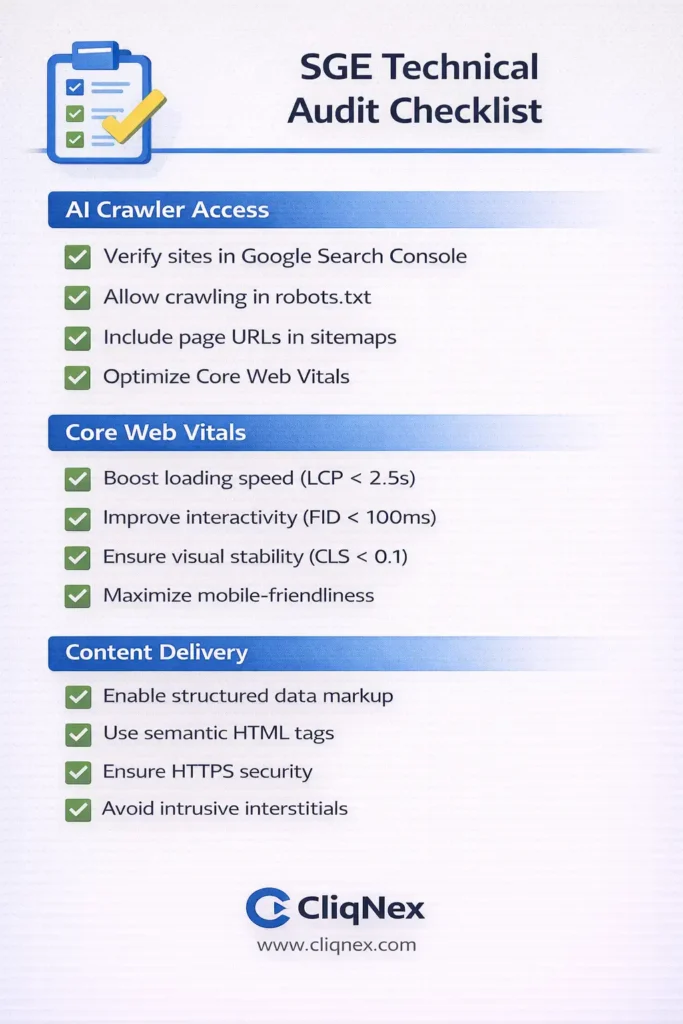
A comprehensive robots.txt audit for AI-era search requires confirming the explicit permission status of the following user-agents:
User-agent: Googlebot
Allow: /

User-agent: Google-Extended
Allow: /

User-agent: GPTBot
Allow: /

User-agent: PerplexityBot
Allow: /

User-agent: ClaudeBot
Allow: /

User-agent: *
Allow: /
Additionally, an emerging standard called llms.txt — analogous to sitemap.xml but designed specifically for large language model crawlers — allows publishers to provide structured guidance to AI systems about how to interpret and cite their content. Early adoption of this standard signals technical sophistication to AI systems and positions sites as cooperative, authoritative sources.
Core Web Vitals in the AI Era
Google’s AI crawlers do not wait for JavaScript-heavy pages to fully render. Content that is only accessible after JavaScript execution — common in React and Angular-based sites — may be entirely invisible to AI Overview sourcing, regardless of its quality. Server-Side Rendering (SSR) ensures that your answer content is present in the initial HTML response, available to AI crawlers on the first request.
The most critical Core Web Vital for AI-era SEO is Interaction to Next Paint (INP) — which must stay below 200 milliseconds. Slow site response signals low trustworthiness to Google’s systems in 2026. Cumulative Layout Shift (CLS) has also gained significance as Google views layout instability as a trust violation indicator.
Measuring SGE Performance: The Metrics That Actually Matter in 2026
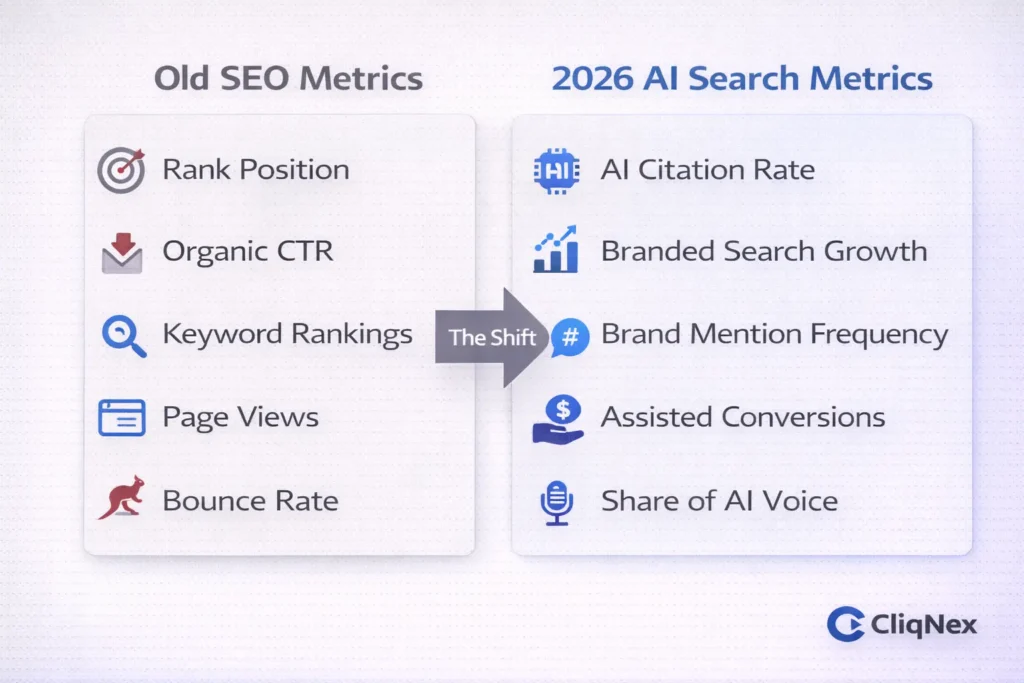
The measurement infrastructure for AI-powered search is still developing, but the tools and methodologies available today are sufficient to build a meaningful performance picture. The critical shift is moving beyond rank position as the primary KPI and building a multi-signal measurement framework that captures both traditional and AI search performance.
Google Search Console for AI Overview Tracking
Google Search Console now displays impression and click data for queries where your content was featured in an AI Overview. The critical diagnostic: when you see queries with high impressions but zero clicks, your content may be fully satisfying the query within the AI Overview without driving through-traffic. This is not necessarily a failure — it signals that your content is citation-eligible. The optimization goal is then to improve the click-worthiness of your citation card to convert impressions into visits.
Third-Party AI Visibility Monitoring
Tools including SEMrush’s Position Tracking feature, Ahrefs’ AI Overview tracker, and dedicated GEO platforms such as Evertune and Geoptie now provide brand citation monitoring across Google AI Overviews, ChatGPT Search, and Perplexity. Tracking your citation frequency, citation position, and the queries for which you are cited gives you the data foundation to iterate your content strategy based on actual AI inclusion performance rather than assumptions.
The KPIs to Retire and the KPIs to Adopt
| Metric Category | Retire (Less Relevant) | Adopt (2026 Priority) |
|---|---|---|
| Visibility | Rank position alone | AI Overview citation rate + rank position |
| Traffic | Raw organic pageviews | High-intent visits + assisted conversions |
| Brand | Direct brand search volume | AI brand mention frequency + LLM perception score |
| Content | Average position per keyword | Share of AI voice across target query clusters |
What Comes After AI Overviews: Future-Proofing for the Next Wave
Optimizing for the current state of SGE and AI Overviews is necessary but not sufficient. The trajectory of AI search is moving faster than any single optimization cycle can address, and the brands that are building compounding advantages today are doing so by preparing for the systems that are already in development.
The Agentic Web: When AI Stops Recommending and Starts Buying
Google’s AI Overviews are a summarization layer. The agentic web — already emerging through OpenAI’s Agentic Commerce Protocol and Shopify’s one-line checkout integration — represents the next transformation layer: AI agents that do not just answer queries but execute actions on behalf of users.
“810 million people use ChatGPT daily. Google AI Overviews hit 1.5 billion monthly users. The debate about whether AI search matters is over. What’s changing in 2026: AI stops recommending and starts buying. The user never leaves the conversation.”
For content creators and SEOs, this means the optimization target is expanding beyond human readers to include AI agents as a primary content consumer. Content that is structured for machine readability — clean schema, explicit factual claims, unambiguous entity data — positions sites for both the current citation economy and the agentic transaction layer emerging in parallel.
Multimodal SGE: Video, Image, and Voice Integration
Google’s Gemini model is inherently multimodal, and AI Overviews are already incorporating video citations through YouTube integration. YouTube receives approximately 48.6 billion visits per month — 8.7 times more than ChatGPT — and Google’s AI systems are increasingly treating YouTube videos as primary citation sources alongside web pages.
For content teams building SGE strategies, video content optimized with detailed transcripts, chapter markers, and descriptive metadata creates a second citation surface that reinforces the authority of the equivalent written content. A pillar article on SGE optimization paired with a YouTube video covering the same framework doubles the citation surface area for that topic cluster.
LLM Perception Drift — The New Brand Metric
Research from AI monitoring platform Evertune introduced the concept of LLM perception drift in late 2025 — tracking how AI models’ assessments of brand authority and relevance shift across retraining cycles. The data shows that brands whose content ecosystem is deeply interconnected across multiple authoritative platforms (web articles, Reddit contributions, GitHub documentation, industry directories) maintain more stable AI brand scores than brands with centralized, single-platform content strategies.
This reinforces a principle that underlies all effective SGE optimization: AI visibility is not a page-level problem. It is a brand-level investment. The most durable AI citation position is built through accumulated authority signals across years and content properties — not through a single article, however well-optimized.
Your SGE Action Plan: 10 Things to Implement This Week
Strategy without implementation is just reading. The following ten actions represent the highest-leverage changes you can make to your content infrastructure right now, ranked by impact-to-effort ratio.
- Audit your
robots.txtfile to confirm Google-Extended, GPTBot, PerplexityBot, and ClaudeBot are explicitly allowed to crawl your site. - Restructure the first 50 words of each H2 section on your top 10 organic landing pages to front-load a direct, complete answer to the question implied by the heading.
- Add Article schema with complete author, publisher, datePublished, and dateModified properties to every content page targeting informational queries.
- Implement FAQPage schema for any page containing a question-and-answer section, ensuring each Q&A pair is structured with the question in the heading and a complete answer in the paragraph immediately following.
- Run a Google Search Console analysis of your top 50 queries to identify terms where impressions are high but clicks are zero — these are your current AI Overview citation pages and the priority targets for click-worthiness optimization.
- Audit the author bio on every published article. Ensure it includes full name, job title, company affiliation, and at least one verifiable credential or third-party mention.
- Map your existing content against a topical authority cluster structure. Identify which pillar articles lack supporting cluster content and schedule cluster articles to close the gaps.
- Review your top five content pages for promotional language in the body sections. Rewrite any sections that read as sales copy into informative, fact-supported prose.
- Run a Core Web Vitals audit prioritizing INP below 200ms. Confirm that key content sections are delivered in the initial HTML response and are not dependent on JavaScript rendering.
- Set up brand mention monitoring in at least one dedicated AI visibility tool (Evertune, Geoptie, or SEMrush’s AI tracking features) to establish a citation rate baseline before your next round of optimizations.
- SGE and AI Overviews are now the primary discovery layer for 50%+ of informational Google queries. Optimizing for citations is no longer optional.
- The path to AI Overview citation runs through traditional SEO fundamentals — Google’s Gemini uses the Google index as its grounding mechanism.
- The 8-point framework (Answer-First Architecture, E-E-A-T, Topical Authority, Conversational Keywords, Schema, Neutral Language, Original Data, Click-Worthiness) addresses both content and technical eligibility for AI citation.
- Technical SGE optimization — especially Google-Extended crawl permissions and SSR content delivery — is the most commonly overlooked and highest-impact quick win available.
- Success in 2026 is measured by citation rate and AI brand mention frequency, not rank position alone. Update your reporting infrastructure accordingly.
- The agentic web is the next transformation layer. Content built for machine readability today will be positioned for the agentic transaction economy already emerging in 2026.
Frequently Asked Questions About SGE Optimization
From Ranking to Being Referenced — The Shift That Defines 2026
The 20-year SEO playbook was built on a single premise: earn the click. Rank high enough, and users will find you. That premise is not dead — but it is no longer the whole game.
Google’s Search Generative Experience has introduced a parallel economy of influence: one where the most valuable form of visibility is not a blue link at position one, but a citation inside the AI-generated answer that 1.5 billion monthly users see before they ever scroll to the organic results. Being referenced is the new ranking. Being cited is the new click.
The 8-point framework in this guide — Answer-First Architecture, E-E-A-T Signals, Topical Authority, Conversational Keywords, Schema Markup, Neutral Language, Original Data, and Click-Worthiness — is not a replacement for traditional SEO. It is the layer you build on top of it. The SEO fundamentals that drove success for the past decade are still the foundation. What changes is the ceiling of what is possible when those fundamentals are paired with AI-specific optimization.
The brands winning in this environment are not the largest. They are the most trusted. And trust, in the AI search economy, is built the same way it was always built — through consistent, authoritative, genuinely useful content, published on a technically sound site, attributed to credible authors, and supported by a content ecosystem deep enough for an AI system to recognize expertise at the domain level.
That is the work. And it starts with the action checklist above.
Ready to Get Your Content Cited in AI Overviews?
CliqNex offers a comprehensive SGE readiness audit — covering your technical crawler access, schema implementation, content architecture, and topical authority gaps. Get a clear picture of where you stand and exactly what to fix.
Request Your Free SGE Audit →