



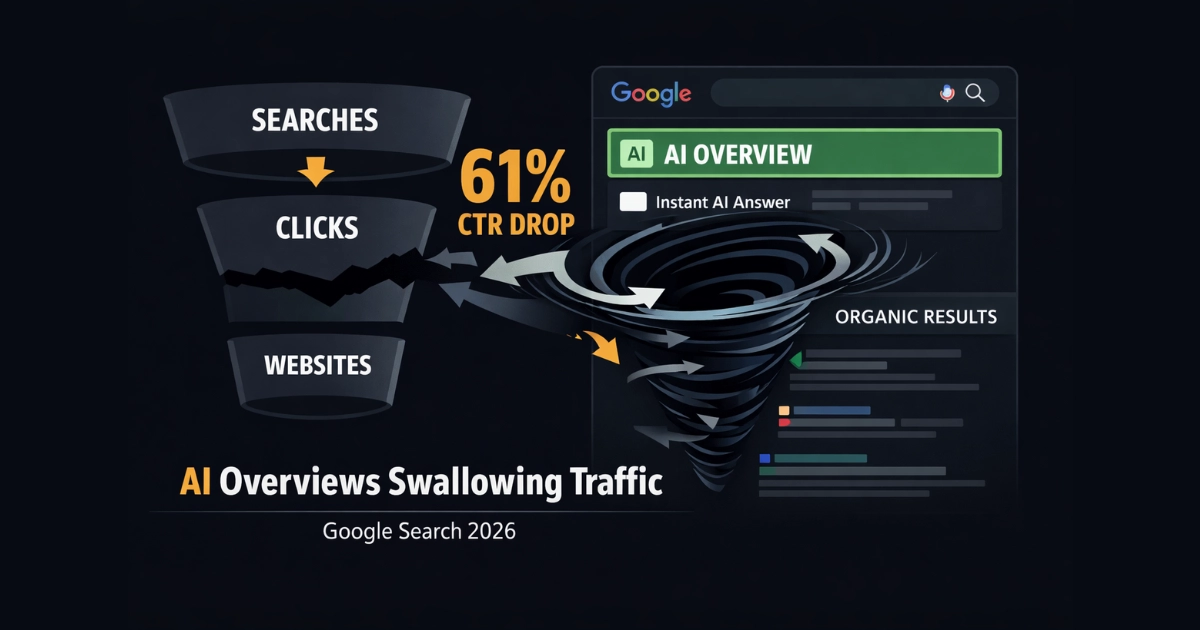
Google’s AI Overviews have cut organic click-through rates by up to 61%. HubSpot lost 80% of blog traffic. Chegg’s traffic dropped by half. But the brands that understand the new rules are already winning. Here is the complete picture — and the exact playbook to fight back.
TL;DR — Key Takeaways
- AI Overviews now appear in 57% of all Google SERPs — up from 25% just 18 months ago.
- Organic CTR for AI Overview queries has dropped 61% year-over-year (June 2024–September 2025).
- HubSpot lost up to 80% of blog traffic. Chegg lost 49%. MailOnline saw 56% CTR collapse.
- This is not a Google penalty. It is a structural shift in how the web delivers answers.
- AI search visitors convert at 4.4× the rate of traditional organic visitors.
- The brands getting cited in AI Overviews are not just surviving — they are growing.
The traffic apocalypse arrived quietly.
There was no algorithm penalty notice. No manual action. No dramatic announcement in Google Search Central. Just a slow, steady bleed — impressions holding steady in Search Console while clicks fell off a cliff. Rankings intact. Traffic gone.
That is the reality thousands of website owners, publishers, and content teams are now living inside. And if you have been watching your analytics with growing unease over the last 12 months, you are not alone — and more importantly, you are not imagining it.
The culprit has a name: Google AI Overviews. Since their full U.S. rollout in May 2024, these AI-generated summaries — powered by Google’s Gemini model and appearing at the very top of search results — have fundamentally changed what happens after a user types a query.
In millions of searches every day, Google no longer sends people to your website. It answers the question itself, synthesizes your content, and moves on.
The data confirms what SEOs have been feeling. Organic click-through rates for queries with AI Overviews have dropped 61% year-over-year, according to Seer Interactive’s analysis of 25.1 million impressions.
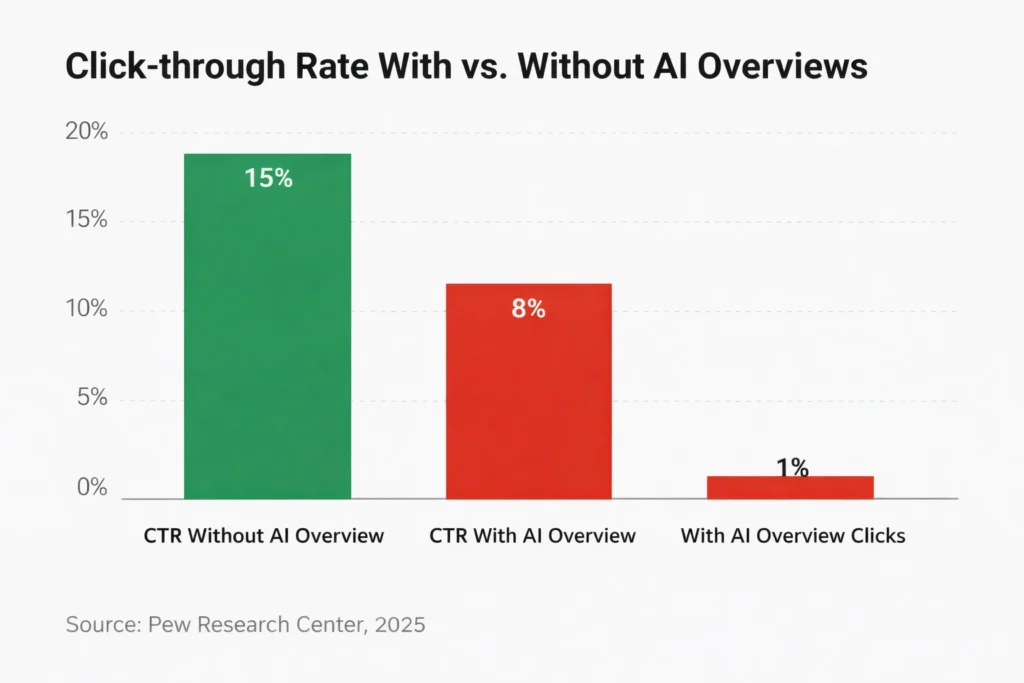
The Pew Research Center tracked 68,000 real user searches and found that when an AI Overview is present, users click a link just 8% of the time — compared to 15% without one. That is a nearly 47% relative collapse in click behavior.
HubSpot — a company with one of the most respected SEO teams on the planet — watched its monthly organic visits fall from approximately 13.5 million in November 2024 to fewer than 6 million by early 2025.
CEO Yamini Rangan acknowledged the shift directly on an earnings call, stating that AI Overviews are “giving answers, and fewer people are clicking through to websites.”
As one industry analyst put it on LinkedIn: “If HubSpot, with one of the best SEO teams in the world, can experience this, none of us are safe.”
This article will not tell you that SEO is dead. It is not. But the version of SEO that relied on ranking for informational queries and harvesting traffic from curious users? That model is under severe and accelerating pressure.
What this article will give you is the complete picture of what is happening, why Google is doing it, who is being hurt most, and — critically — what the brands that are already winning in this new environment are doing differently.
What Are Google AI Overviews — And How Did We Get Here?
Google AI Overviews did not appear overnight. They are the culmination of a decade-long journey toward a search engine that delivers answers rather than directions to answers.
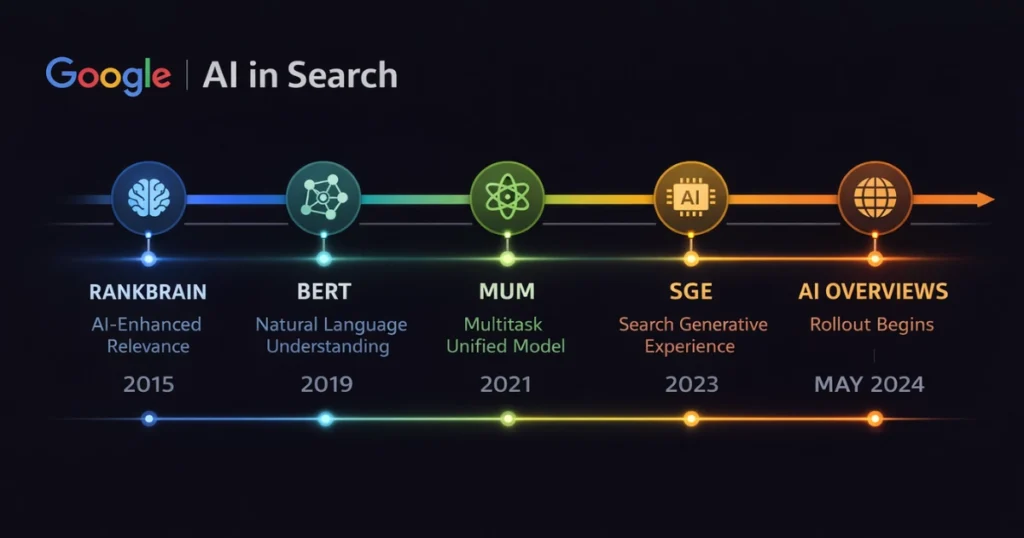
The journey began with RankBrain in 2015, Google’s first machine-learning system for interpreting complex queries. BERT followed in 2019, teaching Google to understand context and nuance in language. MUM arrived in 2021, processing information across multiple formats simultaneously.
Each update moved Google further along a single strategic path: understand what the user wants, and give it to them without unnecessary friction.
In May 2023, Google unveiled the Search Generative Experience (SGE) at Google I/O — an experimental feature that placed AI-generated answers at the top of results pages. It was controversial from day one. Publishers raised alarms. SEO professionals ran tests.
Traffic models were rewritten. Then, in May 2024, Google flipped the switch: SGE became “AI Overviews,” and it rolled out as the default experience for all U.S. users. By October 2024, it had expanded to more than 100 countries. By early 2026, it operates in over 200 countries and 40 languages.
Here is how AI Overviews work in practice: when a user submits a query — particularly an informational or question-based one — Google’s Gemini model reads content from multiple websites, synthesizes the most relevant information, and generates a multi-sentence summary displayed prominently above all organic results.
That summary typically includes a small set of “source” links. But the user rarely needs to click them. The answer is already on the screen.
By The Numbers — AI Overviews in 2025–2026
- AI Overviews now appear on 57% of all Google SERPs globally (June 2025 — Insightland)
- They trigger in 99.9% of informational keyword searches (Ahrefs, November 2025)
- A single AI Overview averages 169 words and includes approximately 7 source links when expanded (Advanced Web Ranking)
- Once expanded, the first organic result is pushed approximately 1,674 pixels down the page — effectively below the fold on most screens
- Navigational AI Overviews grew from under 1% to over 10% of queries in 2025 — now intercepting brand searches too
- Ads appearing alongside AI Overviews rose from 3% in January 2025 to roughly 40% by November 2025
Why This Matters for Your Site
Google is not just answering questions anymore — it is also monetizing those answers with ads. The AI Overview is now a revenue-generating product for Google, which means it is not going away. There is no opt-out mechanism for publishers. Ranking #1 organically is no longer enough to guarantee visibility, let alone clicks.
The Hard Data: Exactly How Much Traffic Are AI Overviews Stealing?
Let us stop theorizing and look at the numbers — because the scale of this shift is larger than most SEOs have publicly acknowledged.
— Seer Interactive, September 2025 (25.1M impressions analyzed)
Seer Interactive analyzed 3,119 informational queries across 42 organizations, spanning 25.1 million organic impressions from June 2024 to September 2025. Their core finding: organic CTR for queries with AI Overviews plummeted from 1.41% to just 0.64%. That is not a seasonal dip. That is a structural collapse in per-query value.
And here is the finding that should alarm every SEO professional: queries without AI Overviews are not bouncing back. They have also lost 41% of their click-through rate year-over-year. The problem extends beyond the AI Overview itself — user behavior is changing everywhere.
The Pew Research Center’s study is the most rigorous conducted to date. By tracking 68,000 real search queries from actual users, researchers found that when an AI Overview is present, only 8% of users click any link — compared to 15% when no AI Overview appears.
Even more striking: only 1% of users click one of the links within the AI Overview itself, despite those links being prominently displayed as “sources.”
SurferSEO’s analysis of 300,000 keywords found that position 1 CTR dropped 34.5% specifically when an AI Overview was present for that query.
Amsive analyzed 700,000 keywords across 10 websites and five industries and found an average CTR drop of 15.49%, with losses spiking to 37% when a featured snippet appeared alongside an AI Overview.
Conductor observed organic traffic drops as large as 60% on specific pages following the rollout. Mail Online, the UK’s largest news website, reported that when it ranks in position one and an AI Overview appears, desktop CTR collapses from 13% to less than 5%.
“On desktop, when we are ranking number one in organic search, clickthrough is about 13%. When we are still ranking number one but there is an AI Overview present, that drops to less than 5%. So a pretty profound change in clickthrough.”
— Carly Steven, SEO & Editorial Ecommerce Director, MailOnline | WAN-IFRA World News Media Congress, May 2025
Zero-click searches — queries that end without any website click — increased from 56% to 69% between May 2024 and May 2025, according to Similarweb data.
That timing aligns directly with the AI Overviews rollout. In 2019, zero-click searches stood at around 50%. The trend has accelerated every year since, but 2024–2025 marked the steepest single-year jump in history.
What This Means for Your Business Model
If your monetization strategy depends on ad revenue tied to pageviews, or if organic search drives lead generation for your business, the math is now working against you. A 61% CTR drop does not mean 61% less revenue — it can mean far more, depending on your conversion funnel. The businesses adapting fastest are the ones reframing success: fewer, higher-quality visits that convert better, rather than high-volume traffic that bounces.
Who Is Getting Hit the Hardest? Industry-by-Industry Breakdown
Not all websites are equal targets. AI Overviews have dramatically different penetration rates across industries — and the sectors built on informational content are bearing the brunt.
Publishers and News Organizations
The publishing industry has absorbed the most visible damage. Google Search consistently accounts for between 20% and 40% of referral traffic to major publishers — making it their largest single external traffic source. When that channel contracts, the impact is immediate and existential.
DMG Media, which owns MailOnline and Metro in the UK, has reported CTR declines approaching 90% for certain search queries.
The Guardian, The New York Times, and BBC have responded by blocking AI crawlers from training on their content entirely — a drastic step that signals how seriously major publishers regard this threat.
Educational Platforms
Chegg, the learning platform that once dominated homework-help searches, reported a 49% decline in non-subscriber traffic between January 2024 and January 2025.
The company filed an antitrust lawsuit against Google in February 2025, alleging that Google trained its AI systems on educational publisher content and now uses that content to answer questions that previously sent users to Chegg’s site.
“For publishers, AI Overviews are a direct hit to traffic and revenue models built around clicks and pageviews.”
— Quoted in Search Engine Journal’s AI Overviews Impact Report, October 2025
SaaS Content Hubs and Marketing Blogs
HubSpot is the case study everyone in SEO is studying right now. Its blog had been one of the most trafficked destinations in the marketing industry, generating over 13 million monthly organic visits at its peak.
The collapse — from 13.5 million visits in November 2024 to fewer than 6 million by early 2025 — exposed a strategic vulnerability that many SaaS companies share.
HubSpot had built its content moat on top-of-funnel informational content: pages about famous sales quotes, cover letter templates, resignation letter examples, and real estate licensing — high-traffic topics with minimal connection to its core CRM product.
When Google began prioritizing content closely tied to a website’s core expertise, those loosely related pages were systematically devalued.
The lesson is not that content marketing does not work. It is that content disconnected from your core expertise is now the most vulnerable asset on your site.
The Sectors With Relative Protection
Not all verticals are equally exposed. Ahrefs’ November 2025 analysis found that Shopping queries trigger AI Overviews only 3.2% of the time. Real estate sits at 5.8%. Sports at 14.8%. These are sectors where users need current, transactional, or locally specific information that AI summaries cannot fully replace.
They are also sectors where the user’s next action — making a purchase, scheduling a showing, checking a live score — requires a destination click.
Local searches remain relatively protected for a similar reason: only 7.9% of local search queries trigger an AI Overview. If someone searches for a plumber in Delhi, no AI summary can replace the act of calling a business.
Why Google Is Doing This — And Why It Will Not Stop
Understanding Google’s motivation is essential before you can build a strategy to respond to it.
Google frames AI Overviews as a feature that enhances user experience — giving people faster, more complete answers.
In blog posts and public statements, the company has emphasized that AI Overviews include citations, that they drive “higher quality clicks,” and that they represent the natural evolution of search.
Google VP of News Partnerships Jaffer Zaidi reiterated in May 2025 that AI Overviews are not triggered for hard news queries and that the feature creates better publisher value.
Publishers see it differently — and the data is largely on their side.
The more important truth is this: AI Overviews are now a revenue product. Ads appearing alongside AI Overviews surged from about 3% of AI Overview SERPs in January 2025 to approximately 40% by November 2025.
Google has found a way to deliver answers and sell advertising around those answers simultaneously — without sending users to publisher websites. The incentive structure has fundamentally changed.
“What happens if the biggest search engine in existence decides that organic listings underneath LLM-generated answers no longer need to be there?”
— Dan Callis, SEO Industry Analyst (15+ years), 2025
There is no opt-out mechanism for AI Overviews. Unlike Featured Snippets — which webmasters can opt out of using the nosnippet meta tag — AI Overviews cannot be blocked without potentially harming your overall search visibility.
Publishers who have tried blocking AI crawlers risk losing rankings entirely. It is a structural trap that has drawn intense criticism from industry organizations, legal researchers, and now antitrust regulators.
“Since Google’s AI Overviews were launched, I — and many others — have shared dozens of examples of spam, misinformation, and inaccurate, biased, or incomplete results appearing in live AI Overview responses.”
— Lily Ray, VP SEO Strategy & Research, Amsive | Search Engine Journal, 2025
“Google’s AI Overviews are terrible at quoting the right sources. There is nothing intelligent about LLMs. They’re advanced word predictors, and using them for any purpose that requires a basis in verifiable facts is fundamentally wrong.”
— Barry Schwartz, Founder, Search Engine Roundtable | News Editor, Search Engine Land | SEO Trends Roundup, 2025
The Bottom Line on Google’s Intent
Google is not going to roll back AI Overviews. The feature is too commercially valuable and too aligned with where user behavior is heading. The question is not whether this shift is permanent — it is. The question is whether your content strategy, authority signals, and traffic diversification are ready for the new rules.
The Silver Lining: The Opportunity Hidden Inside the Crisis
Here is the finding that most doom-and-gloom AI coverage consistently buries: the brands getting cited in AI Overviews are winning.
Seer Interactive’s data found that when your brand is cited within an AI Overview, your organic CTR is 35% higher than when you are simply ranked organically without citation. You receive a visibility endorsement from Google’s AI itself — an authority signal that no amount of traditional SEO work can replicate.
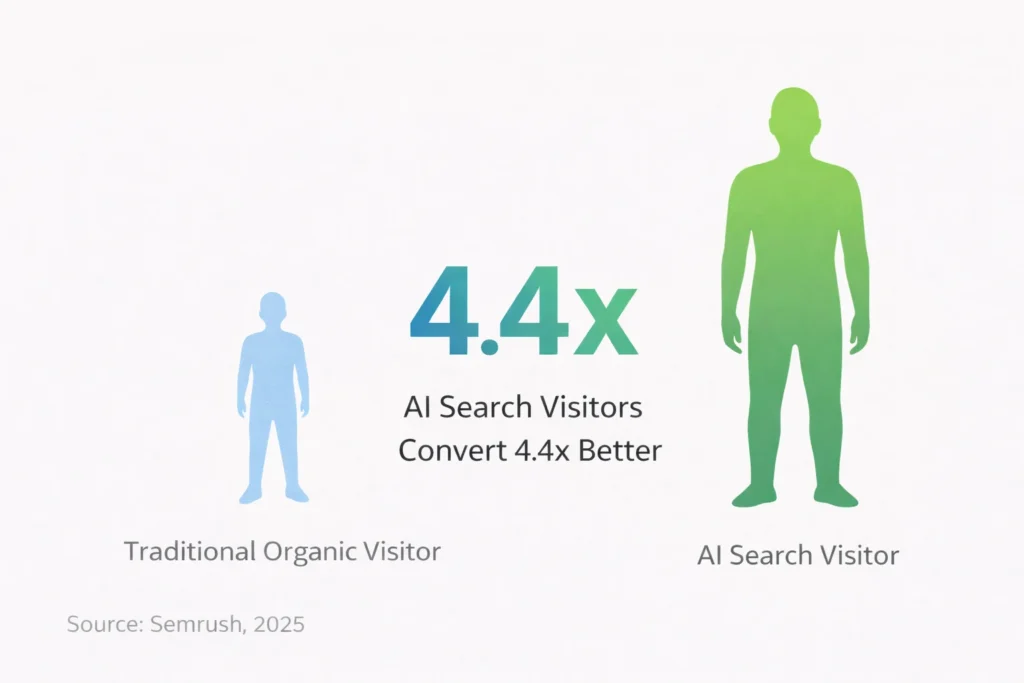
Semrush’s AI search study, one of the most comprehensive conducted to date, found that the average visitor arriving from a large language model converts at 4.4 times the rate of a visitor from traditional organic search.
AI search visitors arrive pre-informed, having already compared options and absorbed your value proposition from the AI’s recommendation. They are not browsing. They are deciding.
LLM-sourced traffic also surged 527% year-over-year between January and May 2025, jumping from 17,076 to over 107,100 sessions across tracked properties, according to the 2025 Previsible AI Traffic Report. ChatGPT alone grew from 600 monthly visits per tracked property in early 2024 to over 22,000 by May 2025.
Rand Fishkin, founder of SparkToro and co-founder of Moz, put the strategic reframe bluntly at SEO Week 2025:
“If traffic is your KPI — that’s what your boss tells you, you get traffic — you’re stuck with search. Your new job is to change behavior, not increase rankings.”
— Rand Fishkin, Founder, SparkToro | SEO Week 2025 Keynote, July 2025
The brands that will thrive in the AI Overview era are not the ones trying to reverse a structural platform shift. They are the ones rewriting their KPIs, rebuilding their content for machine extraction, diversifying their traffic sources, and positioning themselves as the authoritative voice that AI systems trust enough to cite.
The window to establish that authority is open right now — and it is closing.
10 Proven Strategies to Survive — and Win — in the AI Overview Era
These are not theoretical frameworks. These are the specific, data-backed actions that are working right now, drawn from the SEO teams and agencies producing measurable results in the post-AI Overview landscape.
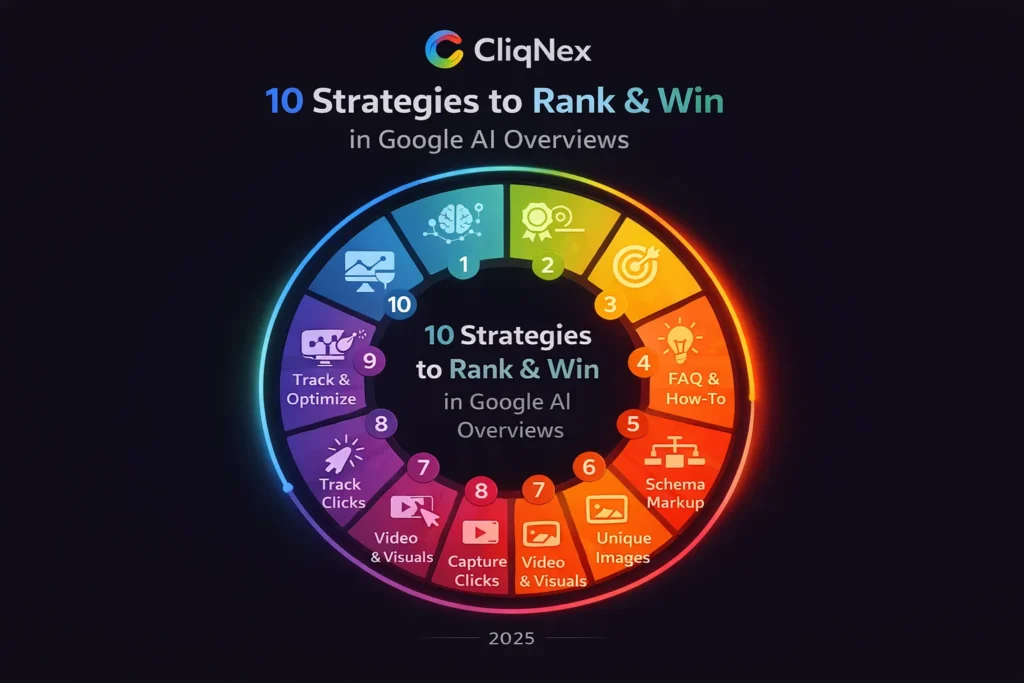
Strategy 01: Shift from Traffic KPIs to Visibility and Conversion KPIs
The first and most important change is in how you measure success. If your primary KPI is total organic sessions, you will be demoralized by data that is structurally declining across the industry.
Grow & Convert’s analysis of 20+ clients found that despite 10–20% traffic declines, conversions from content remained stable or grew — because the users who still clicked were higher-intent visitors.
Measure AI citation rate, branded search volume, conversion rate per organic visit, and share of voice in AI-generated answers. These metrics reflect the new value equation.
Strategy 02: Master GEO — Generative Engine Optimization
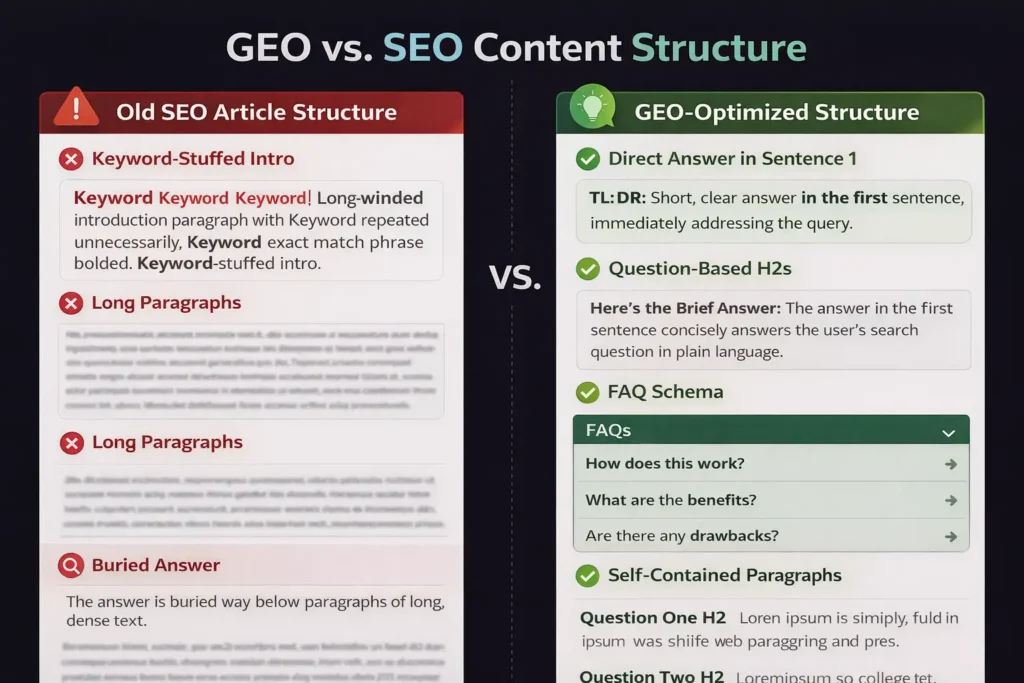
GEO is the practice of structuring your content so that AI systems can easily extract, understand, and cite it. A Princeton/Georgia Tech/Allen Institute study found that proper GEO implementation can improve AI visibility by up to 40%.
The core principles: answer the primary question in the first 1–2 sentences of every section; write in self-contained paragraphs that work as standalone answers; use question-format H2 headings that mirror how users ask queries in ChatGPT or Gemini; and keep sentence length under 20 words wherever possible.
Research confirms that 44.2% of all LLM citations come from the first 30% of a page’s text — your intro is your most valuable citation real estate.
Strategy 03: Implement AEO — Answer Engine Optimization
Answer Engine Optimization focuses on capturing AI citations through structured formatting. Add 3–5 FAQ sections near the end of every article, and mark them up with FAQPage schema — this is the single most-cited content format in AI Overview responses. Use question-based H2 and H3 headings throughout.
Include a TL;DR summary block at the top of each article. Add structured data for How-To guides, product information, and author credibility. Google’s Gemini model, like all LLMs, is designed to extract concise answers — your job is to make those answers impossible to miss.
Strategy 04: Aggressively Target Bottom-of-Funnel Keywords
AI Overviews appear in 99.9% of informational keyword searches but in only 3.2% of Shopping queries and 5.8% of Real Estate queries. The lesson is direct: shift content investment toward bottom-of-funnel keywords — comparison queries, “best [product] for [use case],” pricing queries, and specific “how to choose” searches where user intent is transactional.
Grow & Convert reports seeing only 10–20% traffic declines with their clients because they focus overwhelmingly on bottom-of-funnel terms. Informational-first content strategies built for top-of-funnel traffic are the highest-risk assets in your portfolio right now.
Strategy 05: Build E-E-A-T Signals That AI Systems Trust
Google’s own guidance states that good SEO is good GEO — meaning the same E-E-A-T signals (Experience, Expertise, Authoritativeness, Trustworthiness) that influence traditional rankings also influence AI Overview citation selection.
Every article needs a named author with verifiable credentials and a linked bio. Statistics require inline attribution to named primary sources. Add author schema markup. Build bylines on external publications — digital PR that places your experts in authoritative industry outlets creates the third-party validation that both Google and LLMs use to confirm authority.
BrightEdge’s research confirms that 76% of URLs cited in AI Overviews also rank in the top 10 organic results — you cannot skip traditional SEO foundations.
Strategy 06: Become a Source That AI Systems Cite — Not Just a Destination
The strategic goal is no longer to be the first blue link. It is to become the source that AI builds its answer from. Quora and Reddit are the most commonly cited domains in AI Overviews, according to Semrush’s research. This is because they host specific, question-answering content on niche topics that broader websites do not address.
Create content that answers the precise, niche questions your target audience asks — not just the high-volume head terms. When ChatGPT cites a page, approximately 90% of those cited pages rank in positions 21+ organically, according to Semrush data — proving that AI citation and traditional ranking are increasingly separate games.
Strategy 07: Diversify Traffic Sources Systematically
Neil Patel’s framing of “search everywhere optimization” is the operational standard for 2026. YouTube is the biggest organic winner in an AI Overview-dominated SERP — owned by Google but not subject to AI Overview suppression.
YouTube results appear prominently in 25% of AI Overview SERPs. Create video content that addresses your core topics and link back to your site. Build on LinkedIn (high citation rate in LLMs as of October 2025), Reddit (97.5% presence in product review searches, per Neil Patel’s data), Quora, and niche newsletters.
Own your audience’s email address — it is the one traffic source that Google cannot take from you.
Strategy 08: Optimize for Bing and Alternative AI Platforms
Bing is now strategically important in a way it has never been before. Studies show that up to 87% of SearchGPT citations match Bing’s top results — meaning Bing Webmaster Tools optimization directly improves your visibility in ChatGPT Search.
Additionally, Perplexity AI is growing rapidly as a research tool, particularly among knowledge workers. Optimize your content for how Perplexity surfaces sources: clean site structure, strong backlink profile, and high-quality primary research that no other source publishes.
ChatGPT currently holds 80.1% of AI search traffic market share — but that market is growing fast, and the entry cost for AI visibility is still low enough for smaller sites to compete.
Strategy 09: Refresh Your Content Aggressively and Regularly
AI models favor fresh, accurate content when selecting sources. Outdated statistics and stale examples reduce citation probability. Conduct a quarterly content audit of your highest-traffic pages — replace outdated statistics with the most recent data, add new sections addressing emerging questions in your field, and update your “last reviewed” date stamp visibly.
Google’s AI systems have a freshness signal: content that is visibly maintained performs better in both AI Overview citations and traditional rankings. For time-sensitive industries — SEO, technology, finance, healthcare — this is not optional maintenance. It is a competitive weapon.
Strategy 10: Build Direct Brand Equity and Owned Audience
The deepest long-term protection against any Google algorithm change — including the structural shift represented by AI Overviews — is a direct relationship with your audience. Build your email list aggressively. Launch a newsletter.
Create community spaces on Discord, Slack, or branded forums. The publishers seeing the most resilience in the AI era are the ones with substantial direct traffic (bookmarks, email, branded search) that does not flow through Google at all.
Stuart Forrest, Global Director of SEO at Bauer Media, confirmed to the BBC: “We’re definitely moving into the era of lower clicks and lower referral traffic for publishers.”
The brands with owned audiences do not depend on whether Google sends clicks on any given day.
Is Your Site AI-Ready? The Technical Checklist
Beyond content strategy, there are specific technical implementations that determine whether AI systems can read, understand, and trust your website. Run through this checklist before publishing any new content in 2026.
- FAQPage Schema: Implemented on every article with a FAQ section — the most-cited format in AI Overviews.
- HowTo Schema: Applied to all step-by-step guide content.
- Article/BlogPosting Schema: Includes author name, publication date, and dateModified fields.
- Person Schema on Author Pages: Links author expertise to their byline across articles.
- Organization Schema on Homepage: Name, URL, logo, sameAs fields pointing to all social profiles.
- Clean URL Structure: Descriptive, keyword-containing URLs — critical for AI crawler parsing.
- Core Web Vitals Passing: LCP under 2.5s, INP under 200ms, CLS under 0.1 — speed is an AI citation signal.
- Mobile-First Optimization: AI systems heavily weight mobile usability, particularly for local and voice queries.
- HTTPS and SSL: Non-negotiable for AI trust signals.
- Internal Linking to Topic Clusters: Signals topical authority to both Google’s algorithm and AI crawlers.
- Robots.txt Allows AI Crawlers: Review your robots.txt — do not inadvertently block Googlebot-Extended or other AI crawlers.
- Bing Webmaster Tools Verified: For ChatGPT Search visibility — 87% of ChatGPT citations overlap with Bing’s top results.
How to Measure Success in the AI Overview Era
Traditional SEO metrics — impressions, clicks, average position — are no longer sufficient to understand your true search visibility. Here is the measurement stack that professional SEO teams are building in 2026.
New Metrics That Matter
AI Citation Rate: How often does your content appear as a source within AI Overviews for your target queries? Track this using tools like Semrush’s AI Overview tracker, Advanced Web Ranking’s AI Overview tool, or Peec.ai — which monitors brand citations across Google AI Overview, ChatGPT, Perplexity, Gemini, and Grok simultaneously.
Share of Voice in AI Answers: For your five to ten highest-value topic areas, how often is your brand mentioned when users ask AI assistants the questions your content addresses? This is your new competitive benchmark.
LLM Referral Traffic: Set up separate channel groupings in Google Analytics 4 to isolate traffic from ChatGPT, Perplexity, Copilot, and other AI platforms. This traffic is currently small (2–3% of Google organic volume for most sites) but growing rapidly and converting at 4.4× the rate.
Branded Search Volume: As AI Overviews mention your brand name, users subsequently search for you directly. Branded search growth is one of the clearest leading indicators of AI visibility working in your favor.
Conversion Rate Per Organic Session: If AI Overviews are filtering out low-intent users before they arrive, your conversion rate per session should improve even as total sessions decline. If it is not improving, your content is attracting the wrong audience regardless of AI.
Also Read: Zero-Click Searches Hit 65%: New SEO Strategies for 2026
Adapt Now or Become a Data Source — Not a Destination
The era of publishing informational content, ranking for broad queries, and converting high volumes of curious visitors is over. Not because SEO is dead — it is not — but because Google has changed its fundamental value proposition. It no longer just points people toward answers. It delivers them.
The brands that will thrive in this environment are not the ones trying to fight Google’s AI. They are the ones positioning themselves as the authoritative sources that AI trusts enough to cite. They are building direct audience relationships that do not depend on algorithmic distribution.
They are writing content that a machine can extract and a human can act on. And they are measuring success by conversion quality, not click volume.
Lily Ray, VP of SEO Strategy and Research at Amsive, put it best: “AI visibility is rarely earned without strong SEO fundamentals — and there is still a MASSIVE audience using Google. Publishers just need to work harder to captivate them.”
The window to establish AI citation authority — to become one of the sources that Google’s Gemini and OpenAI’s models consistently trust — is still open.
The brands investing in GEO, E-E-A-T, content freshness, and cross-platform visibility right now are building a moat that will widen over the next two years as AI search continues to grow.
The question is not whether AI Overviews are killing organic traffic. The data has answered that definitively. The question is whether your content strategy is being rebuilt for the world that already exists.
Is Your Website Ready for the AI Overview Era?
CliqNex specializes in GEO, AEO, and AI-first content strategies that position your brand as a source Google’s AI trusts. Get a free AI visibility audit and see exactly where your biggest opportunities are.
Get Your Free AI Visibility Audit →Frequently Asked Questions
What is a Google AI Overview and how does it affect SEO?
A Google AI Overview is an AI-generated summary that appears at the top of Google search results, powered by Google’s Gemini model. It synthesizes information from multiple websites to answer the user’s query directly on the SERP.
For SEO, this means users often receive answers without clicking through to any website, reducing organic click-through rates by as much as 61% for affected queries, according to Seer Interactive’s 2025 analysis of 25.1 million impressions.
How much organic traffic can Google AI Overviews take from my website?
The impact varies by content type and industry. For informational and educational content — how-to guides, definition articles, Q&A content — the losses can be severe. Pew Research Center found CTR drops from 15% to 8% when AI Overviews appear. HubSpot lost up to 80% of blog traffic. Sites in Shopping (3.2% AI Overview presence) and Local (7.9% presence) face significantly lower risk than Science (43.6%) or Health (43%) content.
Can I opt out of appearing in Google AI Overviews?
There is currently no direct opt-out mechanism for AI Overviews. Unlike Featured Snippets, which can be blocked with the nosnippet meta tag, AI Overviews cannot be selectively excluded without risking broader search visibility impacts. Publishers can block specific AI training crawlers (like Google-Extended) from their robots.txt, but this may reduce their chances of being cited as a source in AI Overviews.
What is GEO (Generative Engine Optimization) and how is it different from SEO?
GEO, or Generative Engine Optimization, is the practice of structuring content so AI systems like Google’s Gemini, ChatGPT, and Perplexity can easily extract, understand, and cite it in their generated answers. While SEO focuses on ranking in traditional search engine results pages, GEO focuses on earning AI citations and mentions. In practice, strong SEO foundations — E-E-A-T, technical health, authoritative backlinks — also support GEO performance, but GEO adds specific structural and formatting requirements that traditional SEO does not address.
How do I get my website cited in Google AI Overviews?
To increase your chances of being cited in AI Overviews:
(1) Rank in the top 10 for your target queries — 76% of AI Overview citations come from pages already in the top 10;
(2) Structure content with direct answers in the first 1–2 sentences of each section; (3) Use question-based H2 headings;
(4) Implement FAQPage schema markup;
(5) Build strong E-E-A-T signals with named, credentialed authors;
(6) Keep content fresh with recent statistics and updated publication dates;
(7) Earn citations from high-authority third-party sources through digital PR.
