




Google confirmed the first spam enforcement action of 2026 on March 24 at 12:18 PDT. Here is everything site owners and SEOs need to know right now.
12:18 PDT
Duration
Languages
Update of 2026
Google released the March 2026 spam update on March 24 at 12:18 PM PDT. It is the first spam enforcement action of 2026 and the second confirmed algorithm change of the year, following the February 2026 Discover core update.
The update applies globally across all languages. Google described it using the phrase “a normal spam update,” which is deliberate industry language signaling no new policies were introduced.
This is not a rewrite of Google’s spam framework. It is an improvement to SpamBrain’s ability to detect sites already violating the existing rules. The playbook has not changed. The enforcement just got sharper.
Rollout is still in progress. Do not draw final conclusions from your current ranking data. Check the Google Search Status Dashboard daily. This article will be updated as independent data emerges.
What the March 2026 Spam Update Actually Is
A spam update is a targeted improvement to Google’s automated spam detection system, primarily SpamBrain. It does not reassess overall content quality or topical authority the way a core update does.
It specifically targets sites violating Google’s published spam policies and adjusts their rankings accordingly. Sites not violating policies are generally unaffected in a negative direction.
The March 2024 spam update introduced three entirely new policy categories. The March 2026 update introduces none. The difference: 2024 changed the rules. 2026 enforces the existing rules with greater precision.
Key Distinction
This update is algorithmic, not a manual penalty. You will not receive a Search Console notification. SpamBrain detects violations automatically. A reconsideration request will have zero effect on your rankings.
There is also a winner side to every spam update. If spammy competitors in your niche are demoted, your compliant content may rise. Watch your competitor landscape in Search Console over the next two to three weeks to spot this pattern.
Spam Update vs. Core Update
| Factor | Spam Update | Core Update |
|---|---|---|
| What it evaluates | Specific spam policy violations | Overall content quality and relevance |
| Who is targeted | Sites with active policy violations | Any site, including compliant ones |
| Breadth of impact | Narrower and more targeted | Broader, index-wide reassessment |
| New policies added? | Only sometimes (not in March 2026) | Rarely |
| GSC notification | No (unless a separate manual action) | No |
| Recovery path | Fix violations, sustain compliance for months | Improve content quality, wait for next cycle |
| Can clean sites gain? | Yes, if spammy competitors are demoted | Yes, via quality reassessment |
| Primary detection system | SpamBrain (AI-based) | Multiple core ranking signals |
Exact Timeline: Release, Rollout, and What to Expect
The March 2026 spam update has one of the most precisely documented launch sequences of any recent Google update. Three official channels confirmed it within a few hours of each other.
The “a few days” estimate is significant when placed next to the August 2025 spam update, which ran for nearly 27 full days. The December 2024 spam update completed in approximately 7 days.
A shorter estimate suggests a narrower scope or a more efficient deployment. It does not mean the severity for affected sites is smaller.
Recent Spam Update Rollout Durations
| Update | Start Date | Duration | Notable Pattern |
|---|---|---|---|
| December 2024 Spam | Dec 2024 | Approx. 7 days | Standard enforcement; moderate volatility |
| August 2025 Spam | Aug 26, 2025 | Approx. 27 days | Penalty-only pattern; major visibility losses |
| March 2026 Spam (Current) | Mar 24, 2026 | Est. a few days | First spam update of 2026; no new policies |
Do not use your March 24 ranking data as a baseline. Rankings are in active flux while the rollout is in progress. Establish your true impact window only after the Status Dashboard posts the completion notice.
What SpamBrain Targets: Each Policy Area Explained
No new spam policy categories were introduced with the March 2026 update. The enforcement framework is the same one Google has built since 2022. What changes is SpamBrain’s precision within that framework.
Here is a deep look at each active policy area and what specifically triggers enforcement.
Link Spam
Google prohibits buying or selling links, participating in private blog networks, excessive reciprocal link schemes, automated link generation, and using links as part of service agreements without proper disclosure.
SpamBrain in 2026 does not just flag individual bad links. It evaluates entire link graph structures: velocity of acquisition, anchor text distribution, topical coherence between linking domains and the target site, and ratio of followed to nofollowed links across the full referring domain set.
A site that received 200 backlinks in a single week, all with exact-match anchor text, from domains with no topical relationship to the target site, is sending a multi-signal pattern that SpamBrain is specifically trained to detect.
Critical Warning: Link Spam Recovery Has a Hard Ceiling
Google’s own documentation states: once SpamBrain neutralizes the ranking benefit of manipulative links, that benefit is permanently lost. It cannot be regained.
For content violations, genuine remediation can eventually restore rankings. For link spam, the lost equity is gone. Disavowing prevents future risk but does not restore past positions. This is the most important distinction in spam update recovery strategy.
Scaled Content Abuse
Scaled content abuse means creating large volumes of pages primarily to manipulate search rankings rather than to serve users. The test Google applies is not the volume of pages. It is whether each page provides genuine user value.
Specific behaviors Google prohibits: using AI tools to generate many pages without adding user value, scraping and republishing content with minimal transformation, stitching multiple sources without editorial contribution, and creating near-duplicate pages to cover keyword variations.
In April 2025, Google updated its quality rater guidelines to instruct human evaluators to specifically flag AI-generated pages as “lowest quality” when originality and depth are absent. Those human evaluations feed SpamBrain’s training data over time.
Each spam update cycle is, in part, a deployment of what that feedback loop has produced. The threshold for acceptable AI content production rises with every update.
In December 2025, SEO researcher Lily Ray predicted that a significant AI spam crackdown would be one of the defining enforcement stories of 2026. Whether the March update marks the beginning of that crackdown or a preparatory step before a larger core update remains to be seen. The direction of enforcement is not ambiguous.
CliqNex analysis referencing Lily Ray’s December 2025 predictions on AI content enforcement
Cloaking and Sneaky Redirects
Cloaking is serving different content to Googlebot than to human users. It remains one of Google’s most clearly defined and aggressively enforced violations.
Modern SpamBrain detection extends to JavaScript-conditional content. Sites that show or hide content based on user agent detection are now as detectable as sites that serve different raw HTML. This is a meaningful evolution from earlier systems that could not fully evaluate JavaScript-rendered pages.
Sneaky redirects involve sending users to a different destination than what Google indexed. SpamBrain now evaluates entire redirect chain patterns, not just individual redirect hops. A multi-step sequence that ultimately leads somewhere different than the indexed URL will be flagged even if no single step appears manipulative on its own.
Site Reputation Abuse
Site reputation abuse, also called parasite SEO, is publishing third-party content on an established host domain primarily to exploit its accumulated authority. Google made this a formal policy violation in May 2024.
The March 2026 update arrives against a specific regulatory backdrop for this policy. The European Commission launched an investigation in November 2025 into whether Google’s site reputation abuse enforcement unfairly targets news publishers generating revenue through sponsored content.
Google’s Chief Scientist for Search, Pandu Nayak, characterized the investigation as misguided. The policy remains active. SpamBrain is enforcing it.
The line Google draws: the third-party content must be genuinely integrated into the host site’s editorial mission. Sponsored or partner content published primarily to benefit the third party’s rankings is the violation, regardless of disclosure status.
Expired Domain Abuse
This involves acquiring a previously established domain and publishing content with no relationship to the domain’s original purpose, exploiting inherited ranking signals.
SpamBrain evaluates the relationship between a domain’s link profile and content history versus its current content. A domain that was a cooking resource, now repurposed as a financial services site, is exploiting authority it never earned for that topic.
Keyword Stuffing and Hidden Content
Keyword stuffing detection in 2026 goes beyond raw density ratios. SpamBrain evaluates semantic coherence: whether keyword usage fits natural language patterns or was inserted to signal relevance to a crawler rather than to help a reader.
Hidden content, including CSS-hidden text, zero-pixel fonts, and off-screen elements, falls under Google’s broader cloaking enforcement. Intent does not matter. If crawlers see it and users cannot, it is a violation.
Spam Policy Categories and Recovery Outlook
| Spam Type | Policy Since | Recovery Possible? | Risk Level |
|---|---|---|---|
| Link spam and link schemes | Pre-2022 | Limited Lost equity is permanent | High |
| Scaled content abuse | March 2024 | Yes Clean up and sustain compliance | High (especially AI farms) |
| Cloaking and sneaky redirects | Pre-2022 | Yes Fix technical violations | Medium |
| Site reputation abuse | May 2024 | Yes Remove or improve 3rd-party content | Medium |
| Expired domain abuse | March 2024 | Yes Align content to domain history | Lower |
| Hidden text and keyword stuffing | Pre-2022 | Yes Remove violations | Lower |
How SpamBrain Actually Works in 2026

SpamBrain is not a rulebook. It is a machine learning system trained on confirmed spam examples, capable of identifying manipulation tactics that exhibit similar patterns to known violations even when the specific tactic was never anticipated.
This means each spam update cycle can expand enforcement without changing the published policy. The policies define what is prohibited. SpamBrain’s training improvements expand what it can successfully detect within those categories.
Google’s 2022 Search spam report established the scale: SpamBrain reduced search spam by more than 99 percent compared to the pre-ML baseline. AI-assisted detection operated approximately 70 times more efficiently than rule-based systems had achieved.
The enforcement timeline has also compressed dramatically. In 2012, a link spam violation could take months to manifest as a ranking penalty. Analysis of the August 2025 spam update rollout data indicated SpamBrain now flags suspicious patterns and initiates ranking adjustments in near real-time, within minutes of new manipulative signals appearing at scale.
The enforcement gap used to be measured in months. In 2026, SpamBrain measures it in minutes. The update cadence matters less than the system running continuously between updates.
CliqNex Editorial Analysis, March 2026
One development that deserves attention: in 2024, internal Google documentation surfaced referencing a signal called “BadBackLinks.” This confirmed that a sufficiently contaminated backlink profile can actively harm rankings, not merely fail to improve them.
The practical implication: backlink hygiene is not a reactive cleanup task after a spam update. It is a proactive ongoing requirement in 2026.
Where This Fits in the 2026 Algorithm Calendar
The March 2026 spam update does not exist in isolation. It arrives within a specific sequence of algorithm actions that may already have influenced your site’s performance in ways that complicate attribution.
The December 2025 core update was the most disruptive single update of that year. If your site has not recovered since December, the March spam update may now be adding a second layer of impact on top of an existing deficit.
Attribution Guide
To separate December core update impact from March spam update impact, run three date comparisons in Search Console.
First: October 1 to December 10, 2025 versus December 11 to 29, 2025. Second: December 30, 2025 to March 23, 2026 versus March 24 to present.
Pages that declined in December and further declined in March are potentially affected by both events and need separate remediation strategies for each.
How to Tell If Your Site Is Affected
Correct diagnosis comes before correct remediation. Moving straight to fixes without establishing a clear cause wastes effort and can introduce new problems.
Step 1: Establish the Timing Signal in Search Console
Open Google Search Console, navigate to Performance then Search Results. Set a custom date comparison: March 17-23 versus March 24-30, 2026.
You are looking for one specific pattern: a drop in impressions or clicks that begins on or after March 24, not before. A decline that started in December 2025 is not the March spam update.
Step 2: Identify Which Pages Lost Visibility
Click the Pages tab within the same comparison view. Sort by impressions change to find your most-affected URLs. Export the list.
For each affected page, ask: Is it thin or templated? Was it produced by AI without editorial contribution? Does it exist primarily to target a keyword rather than serve a user need? Does it carry suspicious backlink patterns?
Step 3: Check the Manual Actions Report
Navigate to Security and Manual Actions in Search Console. If no manual action is listed, your impact is purely algorithmic.
This matters because it determines your response. Algorithmic impacts do not respond to reconsideration requests. Filing one wastes your time and has no effect on rankings.
Step 4: Audit Your Backlink Profile
Export your referring domains list from Search Console and cross-reference with a third-party tool such as Ahrefs, Semrush, or Moz. Look for these risk signals across your referring domain set.
- Domains with no identifiable editorial team or content mission
- Domains that link to hundreds of completely unrelated sites
- Exact-match anchor text patterns repeated across multiple referring domains
- Large clusters of referring domains on shared IP infrastructure
- Referring domains that have been recently deindexed or severely demoted
Step 5: Check for Technical Violations
Use the URL Inspection Tool in Search Console to fetch affected pages as Googlebot. Compare what Googlebot sees against what a standard user sees in a browser.
Any discrepancy in content, navigation, or redirect destination is a cloaking signal. Pay particular attention to JavaScript-conditional content that may appear differently to Googlebot than to users.
Core Update Impact vs. Spam Update Impact
| Signal | Points to Spam Update (Mar 24) | Points to Core Update (Dec 2025) |
|---|---|---|
| Drop start date | On or after March 24, 2026 | December 11-29, 2025 |
| Pages affected | Specific pages; often link-heavy or thin content | Broader across multiple content categories |
| Impression pattern | Concentrated drops in specific query clusters | Wide decline across many query types |
| Manual action in GSC | Not present | Not present |
| Competitor movement | Specific competitors rose; likely cleaner spam profiles | Many competitors also shifted broadly |
| Content type affected | Spam signal pages: thin, purchased links, AI farms | Broader quality issues: E-E-A-T, authority, freshness |
The Complete Recovery Guide: 5 Steps with Realistic Timelines
Recovery from a spam update is measured in months, not days. Google’s systems must independently detect sustained compliance before rankings improve. There is no shortcut. There is a clear sequence that represents the highest-probability path.
Complete Backlink Profile Audit and Risk Stratification
Start with a full export of your referring domain list from Search Console, then run it through a third-party tool for domain authority, spam score, and topical relevance data.
Categorize every referring domain into three risk tiers:
- High risk: Link farms, private blog networks, purchased links, recently deindexed domains. These require action.
- Medium risk: Low-quality directories, irrelevant niche sites, abnormally high outbound link ratios. Evaluate case by case.
- Clean: Legitimate editorial placements from topically relevant domains. Leave these alone.
Build a disavow file for high-risk domains where removal outreach has failed. Submit through Search Console.
Understand the ceiling: disavowing removes future risk accumulation. It does not restore ranking positions supported by those links. That equity is permanently neutralized.
Timeline: If rankings were primarily supported by manipulative links, you are not recovering those positions. You are rebuilding from a cleaner baseline. Expect 6 to 12 months of legitimate link acquisition before meaningful recovery.
Content Quality Audit: Flag, Evaluate, and Act on Every Problem URL
Crawl your full site and filter for pages that are candidates for spam designation. Flag pages that match these criteria:
- Under 400 words with no substantive original contribution
- More than 70 percent of content matches material from other sources
- Part of a near-duplicate cluster targeting keyword variations
- No organic traffic for more than 12 consecutive months despite being indexed
- Produced through automated pipelines with no individual editorial review
For each flagged URL, choose one of three options:
- Substantially improve: Rewrite with original research, expert perspective, and genuine depth that makes this page distinctly better than anything else ranking for that query.
- Consolidate: Merge several thin pages into a single comprehensive resource and 301-redirect originals to the consolidated page.
- Delete and redirect: Remove the page and 301-redirect to the most relevant existing page on your site.
Timeline: Initial re-crawling of fixed URLs typically takes 4 to 8 weeks. Consistent ranking improvement from content cleanup takes an additional 3 to 6 months.
Technical Spam Audit: Cloaking, Redirects, and Hidden Elements
Use the URL Inspection Tool in Search Console to fetch a representative sample of your pages as Googlebot. Document any discrepancy between what Googlebot renders and what a user sees.
Check these specific technical areas:
- User agent-based content delivery: Any content shown differently to Googlebot than to real users is cloaking regardless of intent.
- JavaScript-conditional content: Test key pages in a JavaScript-disabled environment to see what Googlebot receives from a non-rendered crawl.
- Redirect chains: Map all redirect sequences. Any chain delivering a different final destination to crawlers than to users is a sneaky redirect.
- Hidden text and links: Run a CSS-disabled render of key pages and identify any text or links visible in that view but hidden in normal user rendering.
Timeline: Technical violations are the fastest to remediate. Once fixed and re-crawled, typically within 2 to 4 weeks, the violation signal clears. Full ranking recovery may take an additional 1 to 3 months.
Third-Party Content Review: Remove Site Reputation Abuse Risk
Audit every piece of content on your domain not produced by your own editorial team: guest posts, sponsored articles, advertorials, affiliate content hubs, and partner-arrangement content.
For each piece, evaluate two questions. First: is this content editorially aligned with your site’s core topic and audience? Second: does it meet the same quality standard as your own first-party content?
Content that exists because of a commercial arrangement rather than editorial merit, and content that is thin, promotional, or exists primarily to include links for a third party, are both site reputation abuse candidates regardless of disclosure.
Note: proper disclosure is required but not sufficient for compliance. Google’s policy is not satisfied simply by labeling content as sponsored. The content itself must serve your audience and meet your quality standards.
Timeline: Site reputation abuse recovery is 3 to 8 months after removing or substantially improving non-compliant third-party content.
Set Up Monitoring Infrastructure and Sustain Compliance
Recovery requires Google’s automated systems to detect sustained compliance over time. The monitoring you set up now determines how clearly you track the recovery arc over the coming months.
- Weekly exports of your Search Console Performance report comparing current week against the pre-March 24 baseline
- Daily check of the Google Search Status Dashboard until the March 2026 rollout completion notice is posted
- A dedicated rank tracker segment for the specific URLs identified as spam-affected during your audit
- Google Alerts for your primary brand terms to track whether demoted competitors begin recovering in your space
What not to do during the recovery period:
- Do not submit a reconsideration request for algorithmic spam update impact
- Do not make sweeping structural changes to your site while the rollout is still in progress
- Do not mass-disavow links without individual evaluation; disavowing clean links can actively harm rankings
- Do not delete significant content volumes without first evaluating consolidation as an alternative
Recovery Timeline at a Glance
Technical violations: 1 to 3 months after fix deployment
Content quality violations: 3 to 6 months after cleanup
Site reputation abuse: 3 to 8 months after removing non-compliant content
Link spam: Lost equity is permanent. New legitimate link equity: 6 to 18 months
AI Content and the Spam Enforcement Trajectory in 2026
The March 2026 spam update arrives at a moment when content producers running AI-assisted pipelines face a genuinely rising enforcement risk. Not because a new rule exists. Because the enforcement capability within the existing rules has improved again.
Google’s position has been consistent: the production method is not the issue. The output quality is. An AI-generated page with original synthesis, genuine expert depth, and clear user value is not targeted.
A page produced by an AI pipeline at scale, with no editorial differentiation, no original contribution, and no purpose beyond ranking for a keyword, is exactly what scaled content abuse enforcement was written to address.
The April 2025 quality rater guideline update added a specific escalation: human evaluators are now trained to flag AI-generated main content as “lowest quality” candidates when depth and originality are absent. Those human evaluations feed SpamBrain’s training data. Each spam update cycle deploys what that loop has produced.
AI Content Risk Framework for 2026
Lower risk: AI-assisted drafting with substantial human editorial review, original research or data, named authorship, genuine topical depth, and individual page-level quality assessment before publishing.
Higher risk: Mass-published AI output with no editorial differentiation, pages that exist to fill keyword gaps rather than user needs, content indistinguishable from thousands of competitor pages on the same topic.
The substitutability test: if a user could get equivalent value from the first two sentences of a competitor’s page, your page does not justify its existence in the index at scale.
Full Google Spam Update History: 2022 to 2026
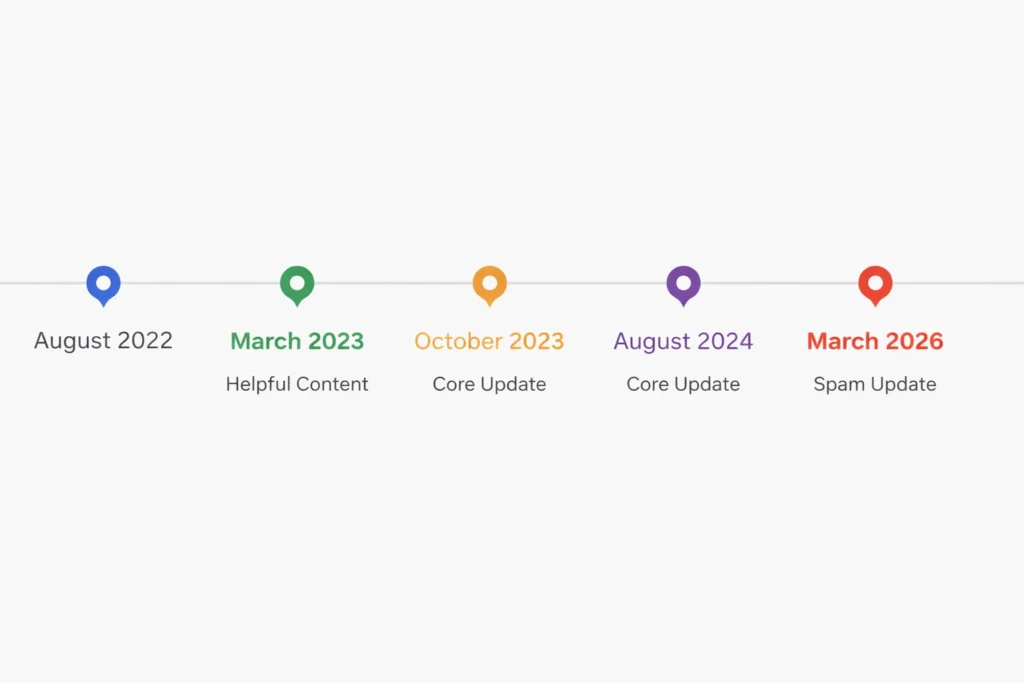
Placing the March 2026 update in its full historical context shows where Google’s spam enforcement has come from and where it is heading.
Complete Google Spam Update History (2022-2026)
| Update | Date | Duration | New Policies? | Primary Focus |
|---|---|---|---|---|
| October 2022 Spam | Oct 2022 | Approx. 48 hours | No | Multi-language spam; Turkish, Vietnamese, Indonesian focus |
| December 2022 Link Spam | Dec 2022 | Approx. 26 days | No | First public SpamBrain deployment for link spam detection at scale |
| October 2023 Spam | Oct 2023 | Approx. 45 days | No | Expanded multi-language enforcement; longest rollout of that year |
| March 2024 Spam | Mar 2024 | Approx. 14 days | Yes: 3 new categories | Scaled content abuse, expired domain abuse, and site reputation abuse defined as formal violations |
| June 2024 Spam | Jun 2024 | Approx. 7 days | No | Enforcement cycle following March 2024 policy expansions; site reputation abuse enforcement began May 5, 2024 |
| December 2024 Spam | Dec 2024 | Approx. 7 days | No | Standard enforcement; moderate volatility in spam-prone niches |
| August 2025 Spam | Aug 26, 2025 | Approx. 27 days | No | Penalty-only pattern; one of the most disruptive recent spam updates; major losses concentrated in high-risk domains |
| March 2026 Spam | Mar 24, 2026 | Est. a few days | No | First spam update of 2026; routine SpamBrain improvement; global scope |
The historical pattern reveals a consistent strategy. Google expanded the policy framework substantially in March 2024. Every update since then has been enforcement-only, without new categories.
The current framework appears complete. Future updates will focus on improving SpamBrain’s detection precision within it. For practitioners, that means the policy landscape is relatively stable. The enforcement capability within it is not.
Frequently Asked Questions
Is the March 2026 spam update a manual penalty?
No. It is fully algorithmic. SpamBrain adjusts rankings automatically with no human reviewer involved. You will not see a Search Console notification. A reconsideration request will not help.
How long does the March 2026 spam update rollout take?
Google says “a few days.” For context, August 2025 took 27 days and December 2024 took 7. Monitor the Google Search Status Dashboard for the official completion notice before drawing conclusions.
Can my site recover from the March 2026 spam update?
Yes for content violations, but recovery takes months. For link spam, lost ranking equity is permanent per Google’s own documentation. Fix violations and rebuild from a clean baseline.
Does this update specifically target AI-generated content?
No new AI-specific policy was announced. However, AI content published at scale without original value falls under scaled content abuse. Google targets output quality, not the production method.
What is SpamBrain and how does it work?
SpamBrain is Google’s ML-based spam detection system, deployed since December 2022. It learns from confirmed spam patterns and detects new manipulation tactics automatically, operating in near real-time in 2026.
What is the difference between a spam update and a core update?
Spam updates target policy violations like link schemes and cloaking, affecting a narrower set of sites. Core updates reassess overall content quality across the entire index, affecting any site regardless of compliance.
What should I check in Google Search Console right now?
Go to Performance, compare March 17-23 vs March 24-30. Look for drops starting March 24. Filter by pages to find affected URLs. Check Manual Actions. No notification means the impact is algorithmic.
What link types does Google target in 2026?
Purchased links, private blog networks, guest post schemes for link acquisition, reciprocal links, and automated link tools. Once SpamBrain devalues these links, the ranking benefit is permanently gone.
The Bottom Line for Site Owners and SEOs
The March 2026 spam update is live and the rollout is ongoing. Google called it a normal spam update, which is accurate: no new rules, just a sharper enforcer.
For sites with clean content and clean backlink profiles, the impact is neutral or positive. Spammy competitors in your space may be losing ground you can gain.
For sites that have been operating in gray areas, the March 2026 update closes more of the enforcement gap. The remediation path is clear. The timelines are honest. And there is one permanent constraint: link equity lost to SpamBrain devaluation does not return.
The broader pattern across every spam update from 2022 through today points in one direction: each cycle the detection system becomes more precise, operates more quickly, and closes more loopholes. The practitioners who sustain organic visibility are not the ones who find new exploits faster than SpamBrain closes the old ones. They are the ones who stopped needing SpamBrain to look the other way.
CliqNex will update this article as the rollout progresses and as independent ranking data from SISTRIX and Semrush Sensor provides clearer evidence of which verticals and content types saw the heaviest enforcement impact. Bookmark and return.

I'm Ankit Prajapati. I've been working in digital marketing for several years, primarily with SEO and paid advertising. I've run campaigns that performed well and campaigns that completely missed the mark. I've seen algorithm updates help sites I was working on and hurt others. I've tested strategies that worked in one industry but failed in another. CliqNex is where I write about these experiences. Not as an expert with all the answers, but as someone who's been in the trenches and learned from the process.